Details: Mike Doyle has created another one of his signature artistic photos of an incredibly textured brick-built scene. This time, it's a poignant political statement about the state of mass media. Normally I'd be a bit hesitant to blog a political model here, but sadly, if you have even a passing knowledge of the LEGO world, you know that many media outlets find it extremely difficult to get even simple details right, like proper use of the name "LEGO" or terms like "LEGO bricks". It's a wonder that we trust the same outlets that very clearly can't cover simple matters fairly or accurately to give us the information we need about local, national, and world events.
That's before we get into the techniques used here - although Mike Doyle's models are only designed to be viewed from one angle, the craftsmanship involved is always top-notch. The backlit fire and smoke features some fascinating angles, most of which seem to be supported with plates with clip lights - which is not the sturdiest connection, so presumably something clever is used in the background to keep the smoke from falling over. Round plates (both 1x1 and 2x2) seem to handle most of the billowing smoke. The included part of the Times logo is a spot-on mix of various slope elements that works without any of the standard mosaic techniques. A visible piece of netting and some bar-and-clip elements hints at additional support for the smoke. The building itself looks a bit simple, but is very effective, making use of the undersides of plates, repetitive parts, and the 2:5 ratio (2 studs wide is the same distance as 5 plates tall - seen here in the window frames) to capture architectural details.
The use of color for the fire and windows may actually be the most noteworthy feature here - Mike Doyle has cultivated a very unique aesthetic based on heavy use of black and white, which makes the color here pop more than it usually would - and makes it all the more impressive that he already seems to have mastered mixing different translucent colors to get the fiery effect seen here.
Available at: Amazon and wherever books are sold. (Disclosure: LMOTD received a review copy)
Details: LEGO idea books turn out to be a surprisingly difficult concept today. Sure, there are many classics, going back to the 60's, but there hasn't been a new one since 1997. After all, since 1995, most LEGO lines have been short-lived play themes - it doesn't make sense for LEGO to publish great ideas for using parts that aren't likely to be easy for kids to find just a year or two later. That 1997 idea book was largely out of date by 1999. The rise of the internet hasn't helped either - usually an adult fan will post photos of great uses for new parts almost as soon as the kits come out.
The LEGO Adventure Book, written by former LEGO designer Megan Rothrock, was pitched to Brickset as something of a sequal to the classic 6000-1 Idea Book. While the Adventure Book does have some things in common with the official idea books, it really doesn't feel much like one. This isn't a small book on magazine-grade paper - it's a solid, 200 page hardcover tome. The brightly colored photos are accompanied by English-language text, which continues an adventure story through the whole book. Of somewhat more interest to LMOTD readers, though, is the 14 sections dedicated to specific builders besides the author. Real names, screen names, professions, nationalities, and URLs are given for each builder before a grouping of their models are showcased. The list of builders featured (they have an index on the last page) should sound pretty familiar: Craig Mandeville, Are J. Heiseldal, Moritz Nolting, Jon Hall, Pete Reid, Peter Morris, Mark Stafford, Aaron Andrews, Mike Psiaki, Katie Walker, Carl Greatrix, Sylvain Amacher, and Daniel August Krentz.
Page 8 introduces us to "Megs", the book's main character, and the next 8 pages show us how to build her "Idea Lab". From there we follow her through a number of "worlds" in her "Transport-o-lux". Megs is a minifigure version of the author, and all of the other builders introduced in the book are also shown as minifigures.
It's hard to say how well the LEGO Adventure Book will stand the test of time - the biggest drawback with idea books. It does make use of parts and colors that may turn out to be short-lived. Right from the beginning, we see parts used that are new for 2012 and unlikely to be readily available to kids in any meaningful quantity. Many of the themes represented will clearly appeal to certain age groups (there are two sections that touch on the Yellow Castle, one classic Space-inspired section, and sections for both Power Miners and Friends). Page 15 shows a great bookshelf technique, but the ends of the shelf are a part that's already been discontinued. In some cases (like the zoo scene), hard-to-find and long-discontinued parts are a major part of a scene that can't easily be worked around. The concept behind idea books has always been to inspire kids to build with parts they already have, and it's likely that this book will have no problem inspiring builders in the future. Some of these models will be out of reach for anyone whose collection doesn't span a few decades, but most of the designs are workable or at least easy to modify to whatever parts are available.
While featuring a variety of fan creations makes it easy to showcase great ideas and tie in with additional material online, it also increases the complexity of the models and the odds that kids won't be able to find the parts (or even be familiar with what sort of parts they're looking at). The various sections highlighting hobbyists and their MOCs are more like the official idea books, in that they largely show completed models that fit a particular theme (along with high-level instructions for a few of the models). While these sections are similar to what many LEGO blogs online already cover (ahem), they look great and serve to canonize a few models in a more concrete way than we can on the internet. However, the URLs are susceptible to the same time-sensitive issues as LEGO part selection - if any of these builders' flickr accounts cease to be accessible in the future, it won't be possible to view their other creations any more (of course, that's also the strongest argument for putting highlights of the hobby community into books like this one in the first place).
I was impressed with the variety of themes represented. The official idea books were always somewhat limited in that they stuck with common themes that LEGO sold sets in, but here, unofficial themes fit in nicely next to the "real" ones. Steampunk and mecha have been staples of LEGO conventions for years, and it was about time someone showed them and explained them in a straight-forward, kid-friendly manner that could be perused away from the convention crowds.
The techniques don't disappoint here either. A number of obscure and seemingly useless parts show up in clever places, all across the book. A "rock dragon" in the Power Miners section is a perfect excuse to show Hero Factory parts in a useful context, and probably my personal pick for the most clever model here. The written advice helps as well - concepts like "mirroring" sections of a model or cutting stickers for details can be explained quickly (as compared with in LEGO instruction books, where complete assemblies are pictures multiple times when they're largely the same).
The LEGO Adventure Book is both a welcome addition to the "idea book" genre and easy to appreciate as a hard-copy document of some of the online LEGO community's best work. The story's ending is a surprising and satisfying twist, although I'm not sure kids will appreciate it as much as seasoned fans (I suppose that's what they generally call "fun for the whole family"). We are (admittedly) biased towards this book due to having covered much of the same ground here, but I was surprised by how strong the book is - after all, idea books are rocky territory.
The LEGO Adventure Book is available starting today from No Starch Press. We've previously featured some of author Megan Rothrock's work. She was kind enough to join us at BrickMagic 2010, while she was still working for The LEGO Group.
Details: This creation pays tribute to Lewis Carroll's classic poem with a brilliant MOC based on Tim Burton's Jabberwock. Not only does it capture the source material extremely well, it also uses fantastic parts usage and shaping to make a surprisingly complex MOC look sleek and whimsical. I highly suggest checking out the MOCpages page to fully appreciate the great design. This was made as part of a VirtuaLUG layout at Brickworld. It is also the most maxome creation I think I've ever seen.
It's no secret that Americans love guns. With the National Rifle Association boasting a staggering 4.3 million members, there are certainly more than a few gun enthusiasts scattered throughout the country. Whether it's hunting, personal protection, competition, or something else – nearly every gun owner has some sort of justification to “pack heat”. However, real guns are often quite difficult to come by (especially outside of the United States). Whether it be their cost or legality, it is often prohibitively difficult to get your hands on a real life bullet spewing hunk of metal. A weekend at the shooting range to actually use your beloved gun of choice, you ask? As anyone who's watched the movie Donnie Brasco would say - "forget about it"!
LEGO, on the other hand, seems to be more and more widely available with every passing day. It's certainly America's favorite building toy, most likely the world’s too. It's everywhere. Found in most corner pharmacies, at the toy store down the street, and no doubt filling multiple shelves and more often than not boasting its own dedicated isle at the local big-box mart – LEGO is omnipresent. Everyone's favorite Danish building block has no doubt won over the hearts and wallets of many with its vivid coloring, robust geometry, and ability to provide endless hours of entertainment. If you're reading this right now, there's a good chance that you have more than a few of the special little blocks in your house too. Tired of building skyscrapers and spaceships? Lost your enthusiasm for finishing that burgeoning train layout? Looking to build something that actually moves or shoots something for a change? LEGO Heavy Weapons by Jack Streat might just be the answer that you've been looking for.
In Mr. Streat's inaugural effort, (which is understandable since he was but a mere 17 years of age when it was published) readers are treated to the complete instructions necessary to construct four replicas of the "world’s most impressive guns". Included in the book are instructions to build a Desert Eagle handgun, a AKS-74U assault rifle, a Lee Enfield sniper rifle, and an SPAS combat shotgun. In addition to being given instructions to construct each gun, one will also be pleased to find a parts listing for each gun that lays out graphically all of the LEGO bricks necessary to construct the weapon in question. If your collection is anything like mine, you’ll likely be able to construct a large portion of any weapon with parts on hand – the only parts I found myself lacking sufficient quantity of were the odd Technic piece here and there. A quick trip to Bricklink.com (click here to download an XML BrickLink parts list) or LEGO’s online PAB, a couple of days wait, and the solution to your woes and the necessary pieces to complete a LEGO weapon of your own a la Mr. Streat should be sitting pleasantly in your mailbox or at your front door.
LEGO guns are an oddity, a rare sight in the world of LEGO. Perhaps it’s the difficulty involved in designing and constructing one out of LEGO. Sure it's easy to build a LEGO "gun"... but, designing a LEGO gun that actually works is a different story. Designing and building a gun that actually projects objects at an accelerated rate of speed towards a target, that’s really quite a feat. While there might not be as many LEGO gun fans as there are regular ones, LEGO Heavy Weapons is doing its part to change this. This isn’t just another book to put on your shelf and never look at again. This is an instruction manual, something to be pored over until every direction contained within its pages has manifested itself into something that you can physically handle. With all the directions needed to build four marvelous LEGO weapons, it’s likely that the pages of this book will be left open for many a day. LEGO Heavy Weapons is more than just a good read, it’s a good build.
Details: If you've been following this blog for a while, you know we love Miniland. The LEGOLAND parks feature not just excellent models at miniland scale, but capture scenes, characters, and locations in ways that are often difficult to do at other scales. The faceless figures are very expressive, and all sorts of great techniques and in-jokes become clear with a close inspection of the models. In the photo shown here, for example, you can see partial minifigs used as puppets for a puppet show. There aren't that many photos in the part of this set we can see, but they're all excellent. The photographer has assembled them into a book and is looking for a publisher - anyone know someone that could make this book happen?
A.B.S. Snorter and his Lego brick sorter,
Will suck up your bricks and do other neat tricks.
He'll place them in bins with nothing but grins,
And sort them by color for only a dollar.
But be careful my friend with the money you spend,
For if it is A.B.S. Snorter you decide to employ,
He may run away with your most precious toy.
The verse above was written by the builder (who also took the lone photograph of this model). Clearly, someone has been inspired by Dr. Seuss. His unique style of illustrating comes across clearly here, as does the whimsical feel of his children's books. The most obvious special technique here is probably the hands - they're made out of minifig arms, but with the minifig hands attaching them to plates with bars and the shoulder joints facing outward. In the back, we see what appears to be falling bricks but turns out to be completely attached. Things are built out in every direction to get the look just right. I particularly love how the arms coming out of the sides are mounted on white steering wheels, which provide a nifty porthole effect.
Name of Model: Hogsmeade Station (these links go to all of this builder's Harry Potter creations, but a Brickshelf Gallery with more photos of this model will be available soon)
Details: There are a dedicated few Harry Potter fanatics who have been building Harry Potter based LEGO models even when no official sets in that theme have been released (they are now reviving the line). While I'm specifically focusing on this fantastic train station, based on Hogsmeade Station, most of the links actually point to the builder's full assortment of Harry Potter-based creations. When re-creating scenes and places from a franchise that has been shown in multiple formats, one of the big issues is deciding which version to build. LEGO recently decided in one of their new kits, The Burrow, that they're tying their version of things to the movies instead of the books. In the case of this model, we're actually seeing a version of the train station that doesn't match the movies, video games, or books - it's an "upgraded" version of the building from after the Harry Potter stories. I guess that means this is technically a Harry Potter "fanfic" model - which I'll allow on the grounds that it's an awesome model. The landscaping, architectural details, and even the minifig posing all comes across as extremely realistic. While this a good example of keeping flashy techniques from getting in the way of a good design, the rear features a footbridge with some fantastic angled sections that only enhance the overall look.
Details: Here is a very simple and elegant design. While I'm not sure this scale is particularly useful, it's a surprisingly recognizable book. Built on a 4x6 plate, and using two of the Slope, Curved 2 x 4 x 2/3 No Studs piece for the middle of the pages, this entire model uses only 8 pieces. Since this is apparently "LEGO book" day here at LMOTD, we'll all be trying to build a few of these.
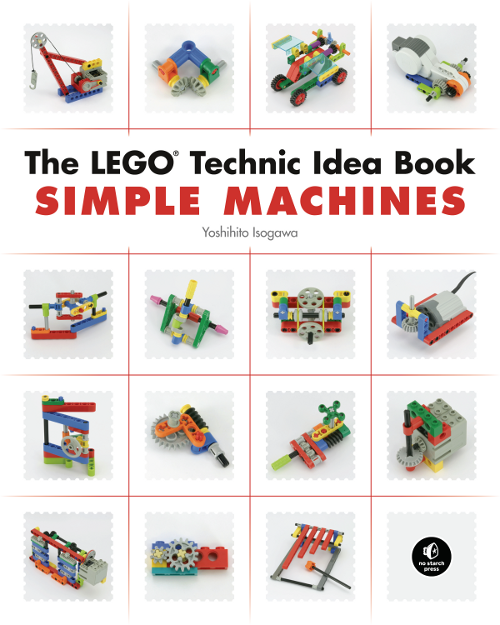
Details: Early this year, I recommended a phenomenal book about LEGO mechanisms. The book was offered in PDF format as shareware. That book is still available in that form, but will soon also be available through No Starch Press in three-volume book form. While there was previously a printed version available in Japanese, this edition will be in English (and of course, the photos are the main attraction). Now the non-mechanical builders out there have even less of an excuse for not adding moving or interactive features to their creations.
Sorry to those of you who read us through RSS or other syndication tools - this is a lightly edited version of the post that originally appeared on September 7th. We're unable to force it to not reappear in the feeds.
LEGO: A Love Story by Jonathan Bender. Wiley; 296 pages; $24.95 or £16.99.
Jonathan Bender is a freelance journalist that lives in Kansas City, he has written for the Huffington Post... and he builds with LEGO bricks. LEGO: A Love Story tells the tale of Jonathan Bender’s initiation into the world of the American AFOL (Adult-Fan-Of-LEGO). From sitting down with a pile of random LEGO bricks and wondering what to build, questioning your building skills, getting your family members into the world of LEGO, attending a LEGO show and convention for the first time; this book covers all of the LEGO community "bases".
LEGO: A Love Story could be considered the first memoir about the LEGO hobby. Never before has the world of the AFOL been documented in this fashion; AFOLs have podcasts, video blogs, magazines, blogs, and online journals, but no full length books. LEGO is a visual medium by nature, bricks come in odd colors and shapes and creations can often defy even the wildest imaginations. So writing a book about the intricacies of LEGO creations and their construction processes without the aid of photographs would be an exercise in futility. LEGO: A Love Story is not about building LEGO creations, but about really building with LEGO, building upon one's character.
A creative work wouldn't be creative if it was everything to everyone, and LEGO: A Love Story does fall short in some areas. The author tends to over describe peoples appearance; their hair color, height, accent, dress, and other peculiarities. Reading the book you are confronted with a plethora of names, places, and numbers. Navigating through all of this can sometimes entail re-reading passages to fully comprehend them; this turns into a nuisance quickly.
Despite the book's short comings LEGO: A Love Story is a great read for any serious LEGO builder trying to get an idea of what the "LEGO community" is like. Whether you’re someone who has just rediscovered your childhood love of LEGO bricks, or someone who has been building with LEGO bricks as an adult for years; LEGO: A Love Story will open your eyes to what can be achieved with a pile of plastic bricks: anything.
LMOTD was provided a review copy of this book. This is Matthew's review, Dan's review will be up as soon as possible.
Here's another "moment of zen" post before I pick a real model for today (I'll probably post one tonight). Spotted at the increasingly silly There I Fixed It:
We've all done this, right? I mean, yes, you should absolutely use sturdier parts than those, particularly if you want to hold books, but still - we've all built fresh shelves. Right? Right?
At least, that's where my QUATRO bricks have been going lately...
Although I've put off featuring them in my "another blog you should read" series, The NXT Step is easily indispensable for us LEGO Mindstorms NXT fans. It may be a difficult read for those of you who aren't technically inclined, but they do try to keep it accessible for all ages. Several of the blog's authors have written books about working with the NXT, and quite a few of them are active in either the LEGO community or the educational community. In lieu of a regular model pick today, here are three recent highlights from The NXT Step:
In other news, the LEGO website has re-posted the online bonus models for the NXT 1.0 kit. They had originally been a casualty of a website update to include newer instructions for the NXT 2.0, but the company has since rectified the error and brought them back. Now, if they could just remember that they need to re-post the bonus instructions for set 8448...
Finally, they recently found a fantastic base for a very large robot on YouTube. The tank treads are made out of Technic beams, and the 9 NXT's and 16 Power Functions motors give this plenty of expense power:
Available at: Amazon (Disclosure: LMOTD received a review copy)
Details:
You may recall that about a year ago, a New York Times blog post featuring sketches in LEGO form of various things (focused on New York city) became something of a viral phenomenon. That post is now coming out in book form, with 13 new illustrations added to the 17 included in the original article. I recently received a review copy and was surprised to find that the book is printed as a small board book - perfect for withstanding use by kids. While none of the sketches are particularly exciting from a technical standpoint, many of them are surprisingly effective at matching the captions. Scale is treated as a non-object, with some pages intentionally referring to things as being at very different scales for comedic effect. Beyond the zen-like simplicity of the illustrations, I think that this book could serve a purpose as a kid-friendly idea book. LEGO hasn't published an official idea book in years (the life cycle of a LEGO set is too short now for that to make any sense - it's no longer safe to assume that a special part will still be available in 6 months, never mind a few years later). While there are many ideas and model photographs online in various venues, I haven't seen anything else that attempts to take very basic (and common) parts and challenges you to see them as everyday objects, people, and places at various scales. Parents who aren't comfortable letting their kids loose online but still want to give their kids LEGO-related ideas will love this (I'm sure it will also help that you could build your own version of anything in the book without more than a handful of parts). While the book is fairly New York-centric, only 6 of the pictures are specific enough to be confusing for non-New Yorkers.
While I'd generally point people interested in LEGO and New York towards more advanced models like Sean Kenney's creations, this book might be a bit more appropriate for youngsters (and parents) trying to figure out how to make something evocative with very few parts.
Details: This isn't exactly a "model" for today, but it's an excellent resource that should help spur on some interesting ideas. Tora no Maki is a book in PDF format that is graciously offered as shareware - you can download it and evaluate it for free, but the author has asked that you pay $10 for it if you use it. Only the opening pages have text (in English and Japanese) - the rest is all full-color photos that clearly show off a variety of techniques. While it's intended to be an educational resource (and is certainly great for beginners - many of the techniques are straightforward and can be built with very few parts), it's still of use even for fairly advanced Technic builders.
This isn't a model per se, but Mariann Asanuma's new book is out. The book is called "Building Secrets from the Masters volume 2: Beyond the Ball" and it builds off of her previous book (I briefly discussed Mariann and her first book, "Building Secrets from the Masters volume 1: How to Build a Round Ball with Square Bricks!" last year). The book features ideas and building instructions for three models: an egg, a hot air balloon, and a watermelon. With her background as a former Master Model Builder for LEGOLAND, Mariann Asanuma naturally has created three models that would each be perfectly suitable as a model of the day.
Details: Back in the 1980's, a travelling show in the US (yes, kids, there really was a time when LEGO operated travelling shows in the United States) featured various elements of Americana shown in LEGO form. One of these was a large (roughly miniland-scaled) model of Mark Twain's house in Hartford, Connecticut. Mark Twain's house is now a museum open year round (not to mention a National Historic Landmark since 1963), and you can learn about the restoration and architecture of the house on the museum's website and at the museum. The LEGO model of the house is now on display inside of the life-size house on "long-term loan", but based on what I've heard about LEGO downsizing its model storage in Enfield, Connecticut, I think it's safe to assume that this model will be there next time you have a chance to visit the Mark Twain house (which we're all doing next time we're near Hartford, CT, right?)
This past week, a life-size sculpture of Mark Twain was unveiled at the museum. The sculpture is itself an impressive collection (note the use of dark orange for the vest) and features radar dishes for the buttons on Twain's clothing. The face is made without too many special techniques, but clearly captures his likeness in tan bricks and plates. You can pose with this glued sculpture at the museum.
As a final entertaining sidenote: those of us who have read the classic and out-of-print book "The World of LEGO Toys" will recognize this model of the Twain house as the unexplained "New England Victorian house" shown in the book. When I first saw that in the book, I remarked that it didn't look much like your average Victorian home in New England, and I wondered why they went with such a large and unusual design - now, the mystery of what inspired this brilliant model has been solved, and we can appreciate the model for it's likeness to the house it is based on.
Continuing on my thoughts from last week, here's another blog I think you should be reading in addition to this one: Mariann Asanuma's Model Building Secrets. Mariann is a former LEGO Master Model Designer who wrote the book "Building Secrets from the Masters volume 1: How to Build a Round Ball with Square Bricks!" - but lately, we've gotten to know her through privately commissioned LEGO work, her spectacular blogging and engagement with the LEGO fan community, and her contributions to BrickJournal magazine. Her unique perspective and knowledge of parts and techniques makes her a must-read. These past few days, however, she's been a great source for news on Comic-Con (you know, that huge comic fan convention LEGO was at last year that I should have mentioned here by now). She's still writing more posts about the event, but for now, check out her Bionicle mosaic built on-site, her Giant Comic-Con logo mosaic and her recap of the LEGO, BrickJournal, and WB booths. It's been a big event (and one I probably should have covered here over the weekend), but Mariann's got it covered.
You can also view her other website, where she promotes her book and her skills as a LEGO artist for hire.
...and if you want more San Diego Comic Con (perhaps you're not just a LEGO fan), you can check out Joe Meno's flickr photostream for more photos than you'll know what to do with.
Additionally, the ULBG has a website and a blog that I have enjoyed reading. All of these are great resources for beginners - if you're one of those parents who has asked about other good resources for kids to build with, Allen Bedford's book, blog, and website are what you're looking for.
Details: Today is Theodor Geisel (also known as Dr Seuss)'s 105th birthday - in celebration of that, Chris at Duckingham Design built this sculpture of green eggs and ham. For those of you unfamiliar with the classic children's book, it's all about a guy named Sam who tries to talk someone into eating the unusual breakfast by suggesting various bizarre situations that it could be eaten in (with a mouse, in a house, with a fox, in a box...)
I know, I know, I'm slacking on Robotics Monday again. This is just as worth-the-time though as the robot of the week usually is, and it's a good resource to use when deciding which books to buy on the topic of building robots. Also, most of these books do include at least one set of instructions for building a robot, so in theory, they could all count as a "model of the day" (OK, fine, I'm stretching it). The site includes a thorough listing of all NXT-based books and includes very brief descriptions of each book as well. Even Japanese-language texts are included! It looks like the website will be updated regularly to include new titles (in fact, an upcoming FIRST LEGO League title is already mentioned there). I, for one, had no idea just how many books were in this genre - I have some catching up to do!

 Mike Doyle has created another one of his signature artistic photos of an incredibly textured brick-built scene. This time, it's a poignant political statement about the state of mass media. Normally I'd be a bit hesitant to blog a political model here, but sadly, if you have even a passing knowledge of the LEGO world, you know that many media outlets find it extremely difficult to get even simple details right, like proper use of the name "LEGO" or terms like "LEGO bricks". It's a wonder that we trust the same outlets that very clearly can't cover simple matters fairly or accurately to give us the information we need about local, national, and world events.


 classic poem with a brilliant MOC based on Tim Burton's Jabberwock. Not only does it capture the source material extremely well, it also uses fantastic parts usage and shaping to make a surprisingly complex MOC look sleek and whimsical. I highly suggest checking out the MOCpages page to fully appreciate the great design. This was made as part of a VirtuaLUG layout at Brickworld. It is also the most maxome creation I think I've ever seen.
  by Jack Streat. No Starch Press; 368 pages; $24.95 and £16.02


 . His unique style of illustrating comes across clearly here, as does the whimsical feel of his children's books. The most obvious special technique here is probably the hands - they're made out of minifig arms, but with the minifig hands attaching them to plates with bars and the shoulder joints facing outward. In the back, we see what appears to be falling bricks but turns out to be completely attached. Things are built out in every direction to get the look just right. I particularly love how the arms coming out of the sides are mounted on white steering wheels, which provide a nifty porthole effect.
 fanatics who have been building Harry Potter based LEGO models even when no official sets in that theme have been released (


 (Disclosure: LMOTD received a review copy)

 covering building in microscale is now available free (and of course, legally) online. The chapter is "Chapter 6: Microscale Building: More Than Meets the Eye" and you can download it in PDF format at
 )'s 105th birthday - in celebration of that,


