Details: Why yes, I'm actually using the name of a model as a post title. This hits the perfect sweet spot for me - it uses great techniques and rare colors to combine two now-classic official LEGO themes. Perhaps you have to had been young in the 1990's to appreciate this; people much older than that tend to think of both Bionicle and Rock Raiders as childish and overly-juniorized themes (on a related note, we really need to have a better summary of what "juniorization" is). A quick check of Ryan's color chart shows that most of the important colors in the Rock Raiders theme's color scheme have been discontinued - teal (Bright Bluish Green [TLG]/Dark Turquoise [BL]) was last in a new set in 2005, and the "great color change" means that we haven't seen old brown (Earth Orange [TLG]/Brown [BL]), old dark grey (Dark Grey [TLG]/Dark Gray [BL]), or old light grey (Grey [TLG]/Light Gray [BL]) in a new set since 2006. Metalized Silver [TLG]/Chrome silver [BL] hasn't exactly been a common color over the years, either, even if it hasn't been discontinued yet.
The colors aren't the only thing to love here - there are also some clever joints and details. Bionicle balljoints are used on the knees to allow two sockets to form a joint together. The same joints are also used in a more traditional (although non-geared) way on the standard Toa torso element (which I'm just now realizing hasn't actually been in a set since 2004) and with a rare black Technic axle towball connected to a Mixel socket to create a very flexible wrist on one hand. Some extra color and body is given to areas that otherwise might look spindly, thanks to the Transparent Fluorescent Green [TLG]/Trans-Neon Green [BL] 1 x 1 round plates pushed into Technic pinholes. The best detail, though, may just be the chainsaw blades coming out of the feet.
Details: While I (Dan) continue to be largely absent due to personal issues (I'm now moving to a new state again), I have still kept building and kept attending events. At one such recent event (this year's BrickFair Alabama), I was interviewed by our friends at Beyond the Brick about my Super Mario Bros.Piranha Plant. While the mechanism still doesn't run smoothly enough for me to be completely happy with it, it's worked well enough to take to shows - but I've been avoiding documenting it online until I've had a chance to make it work better (in this clip, it's already lurching along at a slower speed and sticking a little). I'd like to revise it further to fix the motion problems and to try to capture more of a world from Super Mario Bros. - perhaps with a few more moving characters.
This model debuted at last year's Maker Faire Orlando, which coincided with the 30th anniversary of the original release of Super Mario Bros. It also works out nicely that Piranha Plants were actually green back then (as compared to the red that's currently more common). Not that colors showed up on my classic Game Boy, anyway...
Details: Here's an oldie but a goodie from another contributor of ours here at LMOTD (someone needs to get more comfortable with blogging their own work...). Longtime readers will know I'm a sucker for anything combining themes in an unexpected way - the more themes and the less popular the themes are, the better. Here, we have a wonderful mix of DUPLO Bob the Builder parts with Bionicle and Technic elements. You know I love that. The head/cabin part from Lofty makes the head of the mech. The body is actually an expanding scissor lift, creating a great play feature beyond the decorative details. Clever parts usage such as the Toatorsos for legs are one thing, but this model also has an element of the old ship-in-a-bottle trick. Note how the interior of Lofty's head is filled in with Technic elements (it's more noticeable from the side).
Details: This creation pays tribute to Lewis Carroll's classic poem with a brilliant MOC based on Tim Burton's Jabberwock. Not only does it capture the source material extremely well, it also uses fantastic parts usage and shaping to make a surprisingly complex MOC look sleek and whimsical. I highly suggest checking out the MOCpages page to fully appreciate the great design. This was made as part of a VirtuaLUG layout at Brickworld. It is also the most maxome creation I think I've ever seen.
Details: This beautiful mix of Technic, Bionicle, and "System" elements makes a startlingly convincing vic viper. You can sort of tell where parts begin and end (with how much you can spot likely being a direct function of your level of Bionicle knowledge), but the parts gel together in a way we rarely see with elements that don't usually connect seamlessly. In those few places where a piece would normally create it's own gap, smaller pieces are used to fill those gaps. Don't miss the underside, which shows more traditional elements holding the craft together, providing greebling, and giving us sturdy landing gear.
Details: Although LEGO has made some efforts recently to show us a little more of the design process through theirwebsite, promotional bits, and kit designer presence at LEGO fan events (BrickJournal has opened things up a bit as well), we still don't get too many windows into the design process. Naturally, when we do get a look at the process, it tends to be on lines that encourage us to try creating our own designs in turn - Creator, Technic, or one of the broader playthemes. One reason for that is that the company doesn't want competitors to find out about directions that LEGO could still take at some point in the future. By emphasizing the more creative lines, LEGO can show us some of the design process without leaking unreleased elements and concepts. Today's spotlight is a behind-the-scenes look at set 8694 Krika, a "bad guy" from the Bionicle series. The process is incredibly different, with a focus on intentionally designing new parts, a much greater emphasis on how the result can be posed and played with, and a wildly different price/piece ratio. Even the build is different - simple instructions and a contrasting color scheme were a given for the character. Some things remain the same, though, like how using multiples of the same element can keep production costs down (this also has the happy side effect of making it easier for hobbyists to buy parts in quantity when they were only sold in a few kits).
Another interesting sidenote (considering Bionicle's evolution from a Technic-based line to a more independent action-figure-based line) is that this same designer was also behind some great Technic sets from 2004-2006.
I feel a need to bleg: to the LEGO designers reading this (and I know we have a few) - can you give us a look behind more of what goes on? Obviously, there are reasons why LEGO wants to hold some ideas back, but there's something inspiring about seeing different parts and techniques applied before a set gets scaled back (or otherwise modified) through the process of checking on costs/focus groups/how easy it is to build/marketing concerns/etc.
Details: This "NoVVember" was another strong one for the Vic Viper genre. The final score was 193 Vic Vipers by 88 builders. I'm sure that plenty of them are worthy of a closer look, but this one caught my eye. Right around the cockpit, you can see a few of the trans-neon-green / dark bley rock monster element from a Crystal King set. The various geebly bits around the "lasers" in the front work surprisingly well - but is immediately topped when you realized that the base of that assembly is hidden behind Bionicle foot elements.
Details: Making something that is not a simple action figure out of Bionicle parts: check. Rare colors? How about dark blue AND bright light orange? Clever techniques? How about using rows of sockets to create a pose-able neck? Yes, this fully qualifies as LMOTD bait. The spiky spine on the back of the neck makes fantastic use of the Visorak foor element in quantity. I'm really surprised by how well some of the clunkier parts seem to blend in here - the head makes use of a few parts I'd be tempted to call useless, and that's before we get into the wings or the tail fin.
Details: One thing that LEGO hobbyists have learned over the years is that any piece is more useful if you have a large amount of it. This model is a great example of that - small bits that don't seem terribly useful provide a surprising amount of texture when repeated the way they are here. The builder of this model doesn't seem to be completely happy with the seams - sometimes it's not possible to make a large clear section look perfect with LEGO parts - but I think that the overall effect comes across anyway, and is pretty striking from a distance. Technic brackets create the "round" shape, but once you get past the few Technic support elements, this is largely made of Bionicle goodness. With so many of them going around this chamber, "useless" parts like teeth, plates with Technic holes attached parallel to them, leg armor, sphere launchers, and hoses suddenly become something much more exciting. That's before we get into how great the trans-light-blue panels and 1x1 round bricks look here as the "glass" for this chamber, or how well the top was handled...
Details: If there's such a thing as "LMOTD bait", this is it. Why yes, that is a variation on a Classic Space color scheme. Those really are X-Pod lids used as wheels in the front. That really IS a pair of Bionicle weapons on either side of a large wheel made out of DUPLO tubes. Did I mention the front wheels can be steered by an axle in the middle of the vehicle that is geared to a knob behind the antennae? Yes, it's a minifig-scale Classic space / DUPLO / Bionicle / Technic trike, with working steering, great greebling, and decent construction techniques. This is the good stuff.
That DUPLO tube wheel is mounted on a few tires (which can hold quite a bit with friction, surprisingly), which in turn are connected to the Technic bits and Bionicle weapon. Little more than an inch away from that, we see the Technic structure used as a double-sided element to flip the blue plates (well, this piece) over (yes, this technique's been available for years. You'd be surprised how many seasoned LEGO fans don't know this and continue to whine about how LEGO doesn't make double-sided parts). A few sideways-mounted sarcophagi give us the base of the greebling, and - yes, more places where the studs face a different direction. Many people would think to try something like mounting windshield elements sideways to create a cockpit, but few can build a craft this great all around.
Details: Plenty of people try to capture popular characters in Bionicle form, but few attempts are quite as successful as this one. From the helmet to the cape, the whole body looks solid and believable. As with many of the greatest Bionicle models, this Batman figure relies heavily on more traditional Technic elements to get that solid look while using parts that don't mesh together as solidly as standard bricks. Among there 13 photos of this model, there are close-ups of many smaller sections, a breakdown of the head, and a few shots without the cape. In traditional Bionicle style, the limbs are fully pose-able - even the hands have a few working joints.
Details:
Usually, when I see a model inspired by the Cafe Corner set or following the modular build standard established by that kit, I write about it at Brick Town Talk instead of here (if it hasn't been blogged there already). As I was prepping a post about this model for BTT earlier, more details started to stick out to me - enough to make me realize I should feature it here as well. While this isn't quite a reproduction of the original building that inspired it (shown above right), this conjures up all the right details from the original and fits it into a layout-ready 24 studs (sure, 16- and 32-stud measurements are more common, but it's easy to fit in any multiple of 8 studs as a building width). The gargoyle-esque bits on either side of the top window are Bionicle krana in white. I don't believe we've ever seen them used in a model for minifigs before. Above that same window, we also see a ball joint element and a tooth with axle hole used as architectural details. Spires are made from 1x6 curved slopes, and border detailing makes use of many 2 x 2 curved slope pieces. All those clever bits come in before you even get to the gorgeous detailing at the windows!
Details: You may be familiar with the "impossible to build with" series of Ben 10 Alien Force LEGO action figures. This model takes the Swampfire kit and turns it into a motorcycle. Not so useless now, is it? The wheel assemblies make great use of Technic bits to attach into the few connecting spots that the Ben 10 parts actually have. The handle bars make great use of the minifig gun/torch element to use the holes the Ben 10 torso has for spikes. Rumor has it that that element is being phased out in favor of a newer, simpler mold soon - either way, it's great for turning odd bits intended for bars that fit minifig hands into places you can build off of.
Details: Remember the wings from the 6495 Time Tunnelator kit? I'm sure I'm not the only one who was young in the nineties (OK, not that young...) - the Time Twisters subtheme (and the larger Time Cruisers theme) gets derided for absurd set designs, but they actually came with a slew of rare and hard-to-find parts. The wing element from the Time Tunnelator finds some new use here by obeying the standard rule of bizarre LEGO elements - everything is more useful if you have a large amount of it. Suddenly small printed sail "wings" become giant dragon wings, suitable for an awesome giant Bionicle dragon.
While this particular dragon first surfaced at BrickFair 2010 (where it also looked great in person), it's actually an updated version of a model originally built for the fiftieth BZ Power contest (which was invitation-only for previous Bionicle-Based Building Challenge winners).
EDIT 9/11/2010: Looks like I may have referenced the wrong part and set above. The exact printed pattern visible on the wing elements in the photo above is actually this one, found in three sets (in the Adventurers and Ninja themes) between 1998 and 2000.
Details: Somewhere along the way, the BZPower Bionicle community decided to have a crab crawl-in at BrickFair 2010. While I'm sure they'll look pretty intimidating together as a group, I was planning on not featuring them individually, in spite of the cool techniques that inevitably show up when such small parts are being used. Fortunately, The Un-Sung Brick rounded up a few that are already online. I will be personally making sure we have photos of all of them at the convention - and if they're all as good as what we've seen so far, it's bound to be a great display.
Details:
Combining Bionicle, System, and Technic parts in creation sounds like a bad idea in theory. However (as was shown in Tuesday's post) with a bit of imagination and creativity the difficulty of mixing different parts types can well be worth it. While Cameron G's rendition of a rooster is not a terribly accurate rendition of the real thing, the curves of any animal are difficult or near impossible to render with System elements alone. As shown with this creation, a little creativity and out of the [parts] box thinking can make anything come to life. Being "terribly accurate" doesn't count for terribly much, what does count is being creative with what you do.
To all of our readers who exclusively build with System elements: dump all of the Technic, Bionicle and other odd parts you don't know what to do with or how to use on a table and see what you come up with. You might be surprised!
As a side-note, this creation is planning to make an appearance with a group display at Brickfair 2010 (a LEGO convention outside of Washington DC open to the public on August 7th and 8th 2010).
Details: Here's something I built. It's actually my first true Bionicle creation. I had gotten in the habit of buying used Bionicle sets for the Technic bits and the occasional part that wound up having broader usefulness. What started as a curiosity as to what could be done with these parts turned into inspiration when I saw the large curved panels that started showing up in vehicles in the 2009 line. They looked like they'd make great steam engine boilers in a few different sizes! Before long, I was combining Bionicle parts with some wheels from an Emerald Night set to create this unusual steam engine. It's not terribly practical - you generally want your engine to be heavy to increase traction, and this is extremely light - but it is drivable. The biggest lesson learned here is that building with Bionicle parts is way more fun than it looks. It's actually pretty thrilling when you see those "weird" and "useless" parts actually line up in a meaningful way.
This model will be on display at Brickfair 2010, which is open to the public on August 7th & 8th, 2010 from 11:00 AM - 4:00 PM.
Details: This parrot (a type of macaw) is made largely with Technic parts. While some of the parts are Bionicle specific, most of this is more Technic than Bionicle. Considering the unusual color palettes that LEGO makes Technic pieces in, this is actually a pretty impressive bird. Part of the reason most large Technic creations are black, red, yellow, or colored like a Mindstorms set is that LEGO hasn't made it terribly easy to get parts in some colors. While licensed sets (such as Star Wars, Mickey Mouse, Indiana Jones, Thomas the Tank Engine, Toy Story, etc) tend to drive LEGO to manufacture parts in unusual colors, the Technic line hasn't benefited from this nearly as much, making colors like the green and dark blue seen here all too had to find. LEGO recently reached out to LEGO fans about what colors certain parts should be available in, so perhaps we'll see a better selection of colors for more Technic parts in the future. In the meantime, this is an impressively distinctive structure even without needing to cut the builder slack for color choices. The tail, wings, and beak are nice and clear and even the eyes came out well.
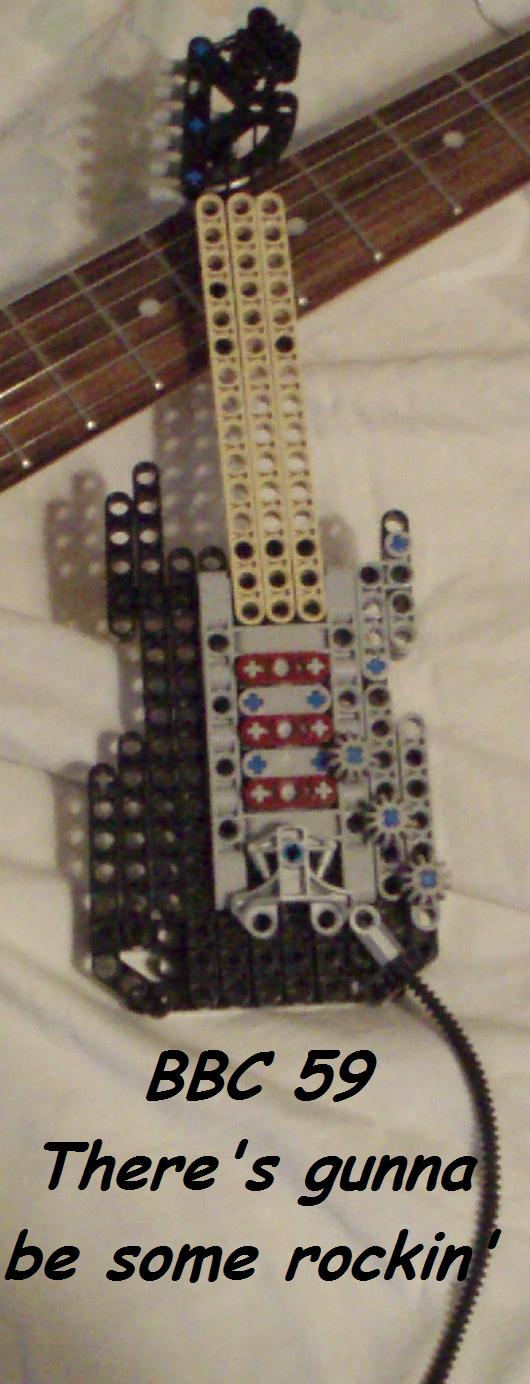
Details: BZPower periodically runs contests in Bionice-based creations. They're now up to BBCC 59, and the theme this time around is "Let There Be Rock". The full entry list is already posted, but the contest ends July 10th. This electric guitar uses Technic beams for most of the body, with gears for the knobs and Bionicle elements for the head, cord, and pickup.
Details: We've seen a few remote-control LEGO boats before (even one other that eschewed common "really floats" parts), but never one that used Bionicle canisters as a flotation device. Yes, kids, you can try playing with floating LEGO creations even if you don't have one of those big expensive "floating boat" kits (We do not recommend that anyone puts electronic LEGO elements near water. Experiment at your own risk). Although this set of photos is only named "boat", it looks like there are photos of multiple boats there - more inspiration for how we could use these plastic canister packages to win those competitive boat races that are increasingly common at LEGO fan conventions!

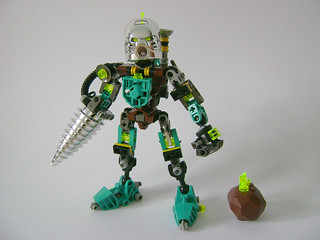 Why yes, I'm actually using the name of a model as a post title. This hits the perfect sweet spot for me - it uses great techniques and rare colors to combine two now-classic official LEGO themes. Perhaps you have to had been young in the 1990's to appreciate this; people much older than that tend to think of both Bionicle and Rock Raiders as childish and overly-juniorized themes (on a related note, we really need to have a better summary of what "juniorization" is). A quick check of Ryan's color chart shows that most of the important colors in the Rock Raiders theme's color scheme have been discontinued - teal (Bright Bluish Green [TLG]/Dark Turquoise [BL]) was last in a new set in 2005, and the "great color change" means that we haven't seen old brown (Earth Orange [TLG]/Brown [BL]), old dark grey (Dark Grey [TLG]/Dark Gray [BL]), or old light grey (Grey [TLG]/Light Gray [BL]) in a new set since 2006. Metalized Silver [TLG]/Chrome silver [BL] hasn't exactly been a common color over the years, either, even if it hasn't been discontinued yet.


 classic poem with a brilliant MOC based on Tim Burton's Jabberwock. Not only does it capture the source material extremely well, it also uses fantastic parts usage and shaping to make a surprisingly complex MOC look sleek and whimsical. I highly suggest checking out the MOCpages page to fully appreciate the great design. This was made as part of a VirtuaLUG layout at Brickworld. It is also the most maxome creation I think I've ever seen.