Posted by
Dan
at
4:53 PM
| Name of Model: Sign of the Times: Failure of the Fourth Estate |
| Created by: Mike Doyle |
| Found at: http://mikedoylesnap.blogspot.com/2014/10/sign-of-times-failure-of-fourth-estate.html |
Details: 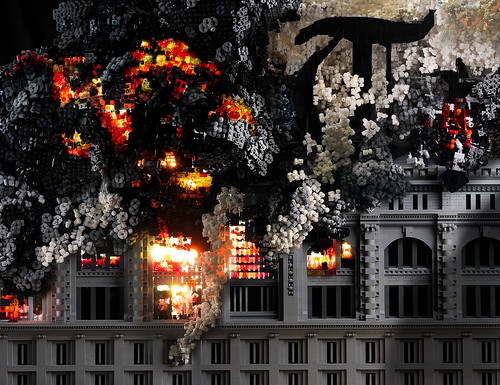 Mike Doyle has created another one of his signature artistic photos of an incredibly textured brick-built scene. This time, it's a poignant political statement about the state of mass media. Normally I'd be a bit hesitant to blog a political model here, but sadly, if you have even a passing knowledge of the LEGO world, you know that many media outlets find it extremely difficult to get even simple details right, like proper use of the name "LEGO" or terms like "LEGO bricks". It's a wonder that we trust the same outlets that very clearly can't cover simple matters fairly or accurately to give us the information we need about local, national, and world events. Mike Doyle has created another one of his signature artistic photos of an incredibly textured brick-built scene. This time, it's a poignant political statement about the state of mass media. Normally I'd be a bit hesitant to blog a political model here, but sadly, if you have even a passing knowledge of the LEGO world, you know that many media outlets find it extremely difficult to get even simple details right, like proper use of the name "LEGO" or terms like "LEGO bricks". It's a wonder that we trust the same outlets that very clearly can't cover simple matters fairly or accurately to give us the information we need about local, national, and world events.
That's before we get into the techniques used here - although Mike Doyle's models are only designed to be viewed from one angle, the craftsmanship involved is always top-notch. The backlit fire and smoke features some fascinating angles, most of which seem to be supported with plates with clip lights - which is not the sturdiest connection, so presumably something clever is used in the background to keep the smoke from falling over. Round plates (both 1x1 and 2x2) seem to handle most of the billowing smoke. The included part of the Times logo is a spot-on mix of various slope elements that works without any of the standard mosaic techniques. A visible piece of netting and some bar-and-clip elements hints at additional support for the smoke. The building itself looks a bit simple, but is very effective, making use of the undersides of plates, repetitive parts, and the 2:5 ratio (2 studs wide is the same distance as 5 plates tall - seen here in the window frames) to capture architectural details.
The use of color for the fire and windows may actually be the most noteworthy feature here - Mike Doyle has cultivated a very unique aesthetic based on heavy use of black and white, which makes the color here pop more than it usually would - and makes it all the more impressive that he already seems to have mastered mixing different translucent colors to get the fiery effect seen here.
In addition to reading about this model here and on Mike Doyle's blog, you can also see it on MOCpages and Flickr.
LMOTD previously covered Mike Doyle's Three Story Victorian with Tree, blog (update) and Two Story with Basement. We seem to have skipped his two books and other MOCs.
|
|
Posted by
Dan
at
8:07 PM
| Name of Model: LEGO Pop-up Todai-ji + Daibutsu (Buddhism) レゴで飛び出る東大寺 |
| Created by: talapz |
| Found at: |
| Details: You may remember the spectacular pop-up model of Kinkaku-ji (the Temple of the Golden Pavilion) from a few years back. More recently, the builder has made another excellent pop-up temple - Nara, Japan's Todai-ji. This one also includes the Daibutsu inside the temple. Around the 1:52 mark, the video switches from a demonstration to CAD-based building instructions, complete with part counts for each step. All 8,816 pieces are accounted for, and there's a complete parts list with BrickLink part numbers at the end. |
|
Posted by
Dan
at
11:56 PM
| Name of Model: 1927 Alabama Theatre |
| Created by: Wesley Higgins |
| Found at: http://www.flickr.com/photos/wesleyhiggins/sets/72157624866985152/ |
Details:  Since the builder did a great job of summing up the history of the source material (follow the links above for that), I'll focus on the building itself here. The first thing that caught my eye was the sign - an elegant mosaic with clear plates as letters. It's actually more complicated than it looks at first glance - it actually gets a plate thicker on each side near the top and bottom, the very top and absolute bottom face different directions than the rest to get the edge of the trim to come out right. The cornicework above the windows is so simple that it barely qualifies as an interesting technique, but the effect comes out perfectly. The entryway looks great, with a current show info, a ticket booth, and old-fashioned outdoor lights. In that same photo, you can see a few plates on the side of the building with their bottoms facing outward - probably held in by using round 1x1 plates wedged in between the studs, with the top of the 1x1 plates connected to Technic bricks. I really like that so much of the surrounding plaza and city scene was recreated here as well - it makes it feel more like a scene out of 1927 instead of a town with a random landmark thrown in. You can see some photos of the source material in the 31-photo flickr set showcasing this model. Since the builder did a great job of summing up the history of the source material (follow the links above for that), I'll focus on the building itself here. The first thing that caught my eye was the sign - an elegant mosaic with clear plates as letters. It's actually more complicated than it looks at first glance - it actually gets a plate thicker on each side near the top and bottom, the very top and absolute bottom face different directions than the rest to get the edge of the trim to come out right. The cornicework above the windows is so simple that it barely qualifies as an interesting technique, but the effect comes out perfectly. The entryway looks great, with a current show info, a ticket booth, and old-fashioned outdoor lights. In that same photo, you can see a few plates on the side of the building with their bottoms facing outward - probably held in by using round 1x1 plates wedged in between the studs, with the top of the 1x1 plates connected to Technic bricks. I really like that so much of the surrounding plaza and city scene was recreated here as well - it makes it feel more like a scene out of 1927 instead of a town with a random landmark thrown in. You can see some photos of the source material in the 31-photo flickr set showcasing this model. |
|
Posted by
Dan
at
12:09 AM
| Name of Model: Bron-Y-Aur |
| Created by: - Derfel Cadarn - (Luke Watkins Hutchinson) |
| Found at: http://www.flickr.com/photos/45244184@N04/sets/72157625305704700/with/5140835613/ |
Details:  Although this spectacular minifig-scale cottage isn't really based on the famous cottage of the same name used by Led Zeppelin in 1970 (sorry, Friends, but That's the Way it's gotta be), I'm going to assume that the name was meant as a nod anyway. Both the landscaping and the architecture here are striking in detail, design, and technique. The subtle use of dark brown, bright green, and dark green works surprisingly well. The tudor style comes off particularly strong, and no small 1x1 element was spared in making the textures on the fence, chimney, or the walls. There are only three photos here, but they're all fantastic and full of life-like details. Although this spectacular minifig-scale cottage isn't really based on the famous cottage of the same name used by Led Zeppelin in 1970 (sorry, Friends, but That's the Way it's gotta be), I'm going to assume that the name was meant as a nod anyway. Both the landscaping and the architecture here are striking in detail, design, and technique. The subtle use of dark brown, bright green, and dark green works surprisingly well. The tudor style comes off particularly strong, and no small 1x1 element was spared in making the textures on the fence, chimney, or the walls. There are only three photos here, but they're all fantastic and full of life-like details.
| | This is Thursday's model of the day |
|
Posted by
Dan
at
10:39 PM
| Name of Model: The Lost Castle in my dream |
| Created by: zgreenz |
| Found at: http://www.brickshelf.com/cgi-bin/gallery.cgi?f=444490 |
Details:  There are plenty of times when you need greebling or architectural details on a model. Sometimes it's just an accent on a larger model, other times (like in this case), nearly every surface looks like a technique study of some sort. Many of the 85 photos of this model are detail shots, some of which even include asides explaining the individual pieces used to get certain textures. Oh, and did I mention that this actually looks like a great castle? There are plenty of times when you need greebling or architectural details on a model. Sometimes it's just an accent on a larger model, other times (like in this case), nearly every surface looks like a technique study of some sort. Many of the 85 photos of this model are detail shots, some of which even include asides explaining the individual pieces used to get certain textures. Oh, and did I mention that this actually looks like a great castle? |
| This is Saturday's model of the day. The pages for the models originally selected for Thursday and Friday were removed before they would have been shared here, so we have removed those posts and will be selecting other models instead. |
|
Posted by
Dan
at
7:55 PM
| Name of Display: LEGO® Architecture: Towering Ambition |
| Created by: Adam Reed Tucker |
| Photos at: http://www.flickr.com/photos/dp3/sets/72157624700188398/with/4881577498/ |
Details:  During my recent trip to BrickFair, I took a short detour to visit the National Building Museum. As I've previously mentioned, they currently have a display of Adam Reed Tucker's work entitled LEGO® Architecture: Towering Ambition. The LEGO display is one of several kid-oriented activities there - some of the other highlights include a separate building area and an arch-building exercise out in the middle of the museum. During my recent trip to BrickFair, I took a short detour to visit the National Building Museum. As I've previously mentioned, they currently have a display of Adam Reed Tucker's work entitled LEGO® Architecture: Towering Ambition. The LEGO display is one of several kid-oriented activities there - some of the other highlights include a separate building area and an arch-building exercise out in the middle of the museum.
The LEGO exhibit features a selection of large landscape models - most of which have some portion intentionally left out so you can get a good look at the internal structure. One model, the White House, was left unfinished so that it can be periodically built during visits from Adam Tucker. The models themselves are mostly noteworthy for their size - the exhibit was well named in highlighting the ambitious heights of the models - and not for their construction techniques. If you look closely, you can even spot a few pieces that are not attached to any other LEGO brick, but rather were glued into place. In our book, that's considered cheating - but I guess it was given the OK since LEGO seems to be supporting the display. About half of the display is devoted to a large play area where kids are encouraged to make buildings and put them on a "map" (the parts, partially donated by the LEGO company, are clearly current to what you can buy in 2010). There's also a gift shop area featuring some of the Adam Tucker-designed LEGO Architecture sets. This exhibit started on July 3rd and runs through September 5, 2011 (yes - you can make it part of a 2011 BrickFair trip).
The National Building Museum is itself an interesting historical structure - it's the "Pension Building" completed in 1887. In my flickr photo set, you can see a few photos of the original building and a minifig-scale LEGO rendition of it - complete with offices. The builder of the LEGO version isn't explicitly credited, but I'd assume that it was also Adam Tucker.
To be honest, I preferred the non-LEGO displays - after seeing landmarks by Arthur Gugick and building part of the new Tower Bridge set at BrickFair, Adam Tucker's large-but-simple-except-for-glue models looked a bit disappointing. Maybe I was getting a bit LEGO'd out after the long weekend of all-LEGO-all-the-time, but I was thrilled to see some of the other displays. If it weren't for the tourist draw of bringing in LEGO fans (and inevitably, families) to see the LEGO-specific display, I actually think a better display would be a larger portion of their construction toys collection.
There were also some great non-LEGO displays (sorry, no pics - photography is prohibited in the non-LEGO exhibits). Cityscapes Revealed: Highlights from the Collection showed a little bit of the collections not open to the public, including photography, bricks (of the fired-clay variety), steel, construction toys, and more I'm certainly forgetting. Washington: Symbol and City was a great treat, featuring historic displays about DC's city planning alongside history of various landmarks and even parts of some of the buildings. Not being able to make time to see more of the city this year, I was thrilled to get to see some of the actual details from various landmarks showcased in the museum - this display is so well-done, it almost justifies not being able to fit in many of the other landmarks during this trip. Drawing Toward Home: Designs for Domestic Architecture from Historic New England was a great look at architectural styles in New England and at how architectural sketches evolved over time.
Overall, it was a great trip, and the "Washington: Symbol and City" exhibit in particular was fantastic. If you're reading this, you'd probably enjoy the LEGO display (especially if you want to try out the play areas), but I'd definitely recommend getting a more thorough look at the museum. The exhibits apparently swap out fairly often, so check the National Building Museum's website to see what's going on before you plan your trip. The museum itself is free (suggested donation of $5) and the LEGO exhibit costs $5 for a scheduled ticket. I have no idea what the schedule is to see more of the White House model being assembled.
|
|
Posted by
Dan
at
9:52 AM
| Name of Model: White House |
| Created by: Adam Reed Tucker for the LEGO Architecture line |
| Found at: My photos: http://www.flickr.com/photos/dp3/sets/72157624442686586/ To purchase: LEGO Shop @ Home |
Details:  Recently, LEGO released a new kit - 21006 White House. Coming in at $49.99 for 560 pieces, this is the best value yet in the LEGO Architecture series (and since this is the first one under the almighty 10-cents-per-piece line, it's also the first one I've actually bought). A decent model of the life-size White House in Washington DC, this captures the general look in microscale on a snazzy base featuring dark green shrubbery, black tiles on the edges, and even a printed tile with "The White House" on it. The build was relatively challenging, with most of the pieces being very small and needing to be lined up just right. There was only one technique that I think an experienced builder (which I'm assuming anyone building this kit - recommended for people age 12 and up - would be) would find surprising, but there were some great offset effects achieved using jumper plates (which this has 64 of) as well. If you're interested in some "spoilers", have a look at my photos of the set, which include build photos, unboxing, and the set inventory. I've also added comments to each photo on that photo's flickr page. Recently, LEGO released a new kit - 21006 White House. Coming in at $49.99 for 560 pieces, this is the best value yet in the LEGO Architecture series (and since this is the first one under the almighty 10-cents-per-piece line, it's also the first one I've actually bought). A decent model of the life-size White House in Washington DC, this captures the general look in microscale on a snazzy base featuring dark green shrubbery, black tiles on the edges, and even a printed tile with "The White House" on it. The build was relatively challenging, with most of the pieces being very small and needing to be lined up just right. There was only one technique that I think an experienced builder (which I'm assuming anyone building this kit - recommended for people age 12 and up - would be) would find surprising, but there were some great offset effects achieved using jumper plates (which this has 64 of) as well. If you're interested in some "spoilers", have a look at my photos of the set, which include build photos, unboxing, and the set inventory. I've also added comments to each photo on that photo's flickr page.
One way I like to judge LEGO kits of landmarks is to compare the official version to hobbyist-designed versions. I'm having trouble finding a fair comparison to this one, though, in terms of scale. Neither of the two I've previously featured are at a similar scale, and Arthur Gugick's other model of the White House is much larger. While the columns here look a bit spindly (they're the lightsaber blade element in white), it's hard to critique fairly without knowing if something better can be achieved at a similar scale.
This set was designed by Adam Reed Tucker, who has been creating model versions of landmarks since long before his LEGO Architecture line came into being. Some of his other LEGO works are now on display in the National Building Museum's LEGO® Architecture: Towering Ambition exhibtion. That display goes from July 3rd, 2010 to September 5th, 2011 - so if you're planning on making the trip to BrickFair in 2010 or 2011, you can make this part of the same trip to the DC area.
Since we usually try to share a little bit of interesting background information here when covering landmarks, here's the official background on the kit:
There are few structures in the United States with the history and reverence of The White House, designed by James Hoban. On July 16, 1792, President George Washington chose this James Hoban design from six competing designs from renowned architects. This six-story Sandstone structure was meant to command respect for the nation from citizens and foreign visitors. Construction took place from 1792 - 1800 and it was rebuilt by Hoban following the fire of 1814. The assembled White House model stands 9" (22 cm) wide on a base with printed name label and includes a booklet with facts about the building, its construction and its history.
Disclosure: I received a free awesome little Spaceman magnet when I bought this, and you can too buy spending $75 at LEGO Brand Retail this July, while supplies last. |
|
Posted by
Dan
at
4:00 AM
| Name of Model: Fallingwater |
| Created by: Matija Grguric |
| Found at: http://www.flickr.com/photos/matijagrguric/sets/72157623778661188/ |
Details:
 A while back (we didn't mention it because we don't feel comfortable recommending it due to the extremely high price per part ratio), LEGO released an official Fallingwater kit that is very faithful to the original structure designed by Frank Lloyd Wright. The trouble with the official sets in the Architecture theme and other kits that build landmarks (such as the Taj Mahal, which is currently $50 off) is that the limits of currently available parts and acceptable pricing ensure that no matter what the LEGO company can sell in a kit, it'll be possible for a fan to do a better job with the same source material. In this case, we see Fallingwater rendered at a 1:40 scale (roughly minifig scale, although minifig dimensions are blurry enough to not really fit any scale exactly) instead of the microscale of the original kit. Also interesting about this model is that this one is clearly in a wintery season - note the spindly, leafless trees and the dark icy water. A while back (we didn't mention it because we don't feel comfortable recommending it due to the extremely high price per part ratio), LEGO released an official Fallingwater kit that is very faithful to the original structure designed by Frank Lloyd Wright. The trouble with the official sets in the Architecture theme and other kits that build landmarks (such as the Taj Mahal, which is currently $50 off) is that the limits of currently available parts and acceptable pricing ensure that no matter what the LEGO company can sell in a kit, it'll be possible for a fan to do a better job with the same source material. In this case, we see Fallingwater rendered at a 1:40 scale (roughly minifig scale, although minifig dimensions are blurry enough to not really fit any scale exactly) instead of the microscale of the original kit. Also interesting about this model is that this one is clearly in a wintery season - note the spindly, leafless trees and the dark icy water.
In the interest of being thorough and giving you all of the display and construction details, I'm stealing the description of this model that appears with most of the photos:
Building info:
Fallingwater, also known as the Edgar J. Kaufmann Sr. Residence, is a house designed by American architect Frank Lloyd Wright in 1934 in rural southwestern Pennsylvania, 50 miles southeast of Pittsburgh. The house was built partly over a waterfall in Bear Run at Rural Route 1 in the Mill Run section of Stewart Township, Fayette County, Pennsylvania, in the Laurel Highlands of the Allegheny Mountains. For the rest of the information regarding the house please visit Wikipedia.
Project:
I've had thoughts about this project since I've built Le Corbusier's Villa Savoye. I finally made up my mind in September 2009. when I began planning and working on some early designs. Scale of the building is minifig, or approximate 1:40. One of the issues was how to make the stone walls of the building. The result here is made out of 4 different shades of grey (old grey and bley). Other was the terrain and vegetation. In the end I decided to make it in winter atmosphere. Snow is something I always enjoy, and I was always more of a winter type of person, so here it is - my first snowy MOC. :)
Building process spread over total of almost 7 months, and the structure is made out of more than 15000 bricks (just an approximate guess). It is placed on 6 48*48 baseplates, and measures 115 x 80 x 50 cm. It weights more than 20 kg. This MOC will be displayed in Technical Museum in Zagreb on "Kockice EXPO 2010", in May and June this year.
I would like to thank dear Klementina for her help and support during the rough times - multiple structure collapses. ;) Check it out at the links above and/or at the museum in Zagreb in the coming months - this is an excellent model.
|
|
Posted by
Dan
at
4:00 AM
| Name of Model: MC Daly Building |
| Created by: Bisonfuehrer |
| Found at: http://www.flickr.com/photos/bisonfuehrer/4401683924/ |
Details:
 Another micropolis masterpiece. While using translucent parts isn't exactly a new technique, it's used to great effect here. The trans-black color works really well with the black plates. If you study this design closely, you'll see that there are a few places that don't line up quite the way you'd expect. Those details are achieved by using the flat side of log bricks - since those are a little narrower than normal bricks at the ends, they can be used to add a bit more texture. Another micropolis masterpiece. While using translucent parts isn't exactly a new technique, it's used to great effect here. The trans-black color works really well with the black plates. If you study this design closely, you'll see that there are a few places that don't line up quite the way you'd expect. Those details are achieved by using the flat side of log bricks - since those are a little narrower than normal bricks at the ends, they can be used to add a bit more texture. |
|
Posted by
Dan
at
12:04 AM
| Name of Model: built using simple bricks and plates. MOC for doublebrick.ru contest |
| Created by: CoolerTD |
| Found at: http://www.brickshelf.com/cgi-bin/gallery.cgi?f=422956 |
Details:
 Every once in a while, a fantastic model from somewhere else in the world reminds you of just how many great things you don't see because of language barriers. Sure, we all post photos to some of the same websites, but language barriers still prevent us from participating in certain contests or clearly communicating in words about various techniques. This particular contest (as explained by the builder in an English-language forum - the original contest was held on a Russian website, and as such info about this model is written in Russian) requires participants to design and build an original creation using only basic bricks and plates. At some level, it's pleasantly classic, going back to what people tend to think of as "pure" LEGO. On the other hand, it forces you to give up on many beloved building techniques. Or does it? - in this triumphal arch, we see bricks laid sideways (held in place only by friction and exact geometry), plates wedged between studs (with other small plates in between, only loosely attached), and plates partially connected on a curve to get that distinctive arch shape. This is extremely impressive for a model using only the most basic of LEGO elements! Every once in a while, a fantastic model from somewhere else in the world reminds you of just how many great things you don't see because of language barriers. Sure, we all post photos to some of the same websites, but language barriers still prevent us from participating in certain contests or clearly communicating in words about various techniques. This particular contest (as explained by the builder in an English-language forum - the original contest was held on a Russian website, and as such info about this model is written in Russian) requires participants to design and build an original creation using only basic bricks and plates. At some level, it's pleasantly classic, going back to what people tend to think of as "pure" LEGO. On the other hand, it forces you to give up on many beloved building techniques. Or does it? - in this triumphal arch, we see bricks laid sideways (held in place only by friction and exact geometry), plates wedged between studs (with other small plates in between, only loosely attached), and plates partially connected on a curve to get that distinctive arch shape. This is extremely impressive for a model using only the most basic of LEGO elements! | | This is Saturday's model of the day |
|
Posted by
Dan
at
4:00 AM
| Name of Model: Governor's Palace |
| Created by: Arthur Gugick |
| Found at: http://www.flickr.com/photos/10321180@N08/tags/colonial/ |
Details:
 This model of the Governor's Palace in Williamsburg, Virginia is so full of exciting techniques that it is difficult to get a proper sense of scale looking at these photos. There's a very realistic brick texture visible here that is achieved by mixing 1x2 plates of various colors (with dark red and reddish brown going together very well). Of course, once you realize how small the "bricks" in the walls really are, the next question is "What's really in those windows?" The answer (clearer if you zoom in) is that they're the newer 1x2x3 and 1x2x2 windows, but instead of glass in the windows, there are 1x2 grill tiles mounted sideways behind them. The effect is spectacular - these really little windows really look like they have very tiny shutters behind them. That's not the only interesting parts use that makes it hard to tell what size this is - roofs are built out of cheese slopes, and the "grass" is actually made of leaf elements. Even the front door is an interesting trick - that's made with stacked hinge bricks. The rotunda makes use of the more well-known technique of using plate hinges to angle some of the windows. This model of the Governor's Palace in Williamsburg, Virginia is so full of exciting techniques that it is difficult to get a proper sense of scale looking at these photos. There's a very realistic brick texture visible here that is achieved by mixing 1x2 plates of various colors (with dark red and reddish brown going together very well). Of course, once you realize how small the "bricks" in the walls really are, the next question is "What's really in those windows?" The answer (clearer if you zoom in) is that they're the newer 1x2x3 and 1x2x2 windows, but instead of glass in the windows, there are 1x2 grill tiles mounted sideways behind them. The effect is spectacular - these really little windows really look like they have very tiny shutters behind them. That's not the only interesting parts use that makes it hard to tell what size this is - roofs are built out of cheese slopes, and the "grass" is actually made of leaf elements. Even the front door is an interesting trick - that's made with stacked hinge bricks. The rotunda makes use of the more well-known technique of using plate hinges to angle some of the windows. |
|
Posted by
Dan
at
2:14 AM
| Name of Model: 2009 - sliding house | | Created by: d-higdon | | Found at: http://www.flickr.com/photos/buildingsblockd/sets/72157622746033729/ | Details:
 The Russell House is an unusual house in Suffolk, England. What makes it so unusual is that it is a sliding house - a large exterior roof with walls literally slides along the house, allowing for parts of the house to be "open" or "closed", and for a large chunk of the house to appear to be made almost entirely of windows. I'm not sure how the real house was dreamed up or brought into reality, but the LEGO version makes much more sense - I mean, who hasn't tried to build a transforming house before? Right? Or maybe it's just me... The Russell House is an unusual house in Suffolk, England. What makes it so unusual is that it is a sliding house - a large exterior roof with walls literally slides along the house, allowing for parts of the house to be "open" or "closed", and for a large chunk of the house to appear to be made almost entirely of windows. I'm not sure how the real house was dreamed up or brought into reality, but the LEGO version makes much more sense - I mean, who hasn't tried to build a transforming house before? Right? Or maybe it's just me...
For those of you unfamiliar with this LEGO builder (I don't believe I've blogged about her before), she's actually fairly well-known in the LEGO fan community for her clever parts use "studies", which have led to very exciting furniture, staircases, and other extremely realistic interior details. As you might expect, that high level of quality is also shown on the interior of the LEGO version of this house.
|
|
Posted by
Lego Model of the Day
at
4:00 AM
|
Posted by
Brickapolis
at
8:57 PM
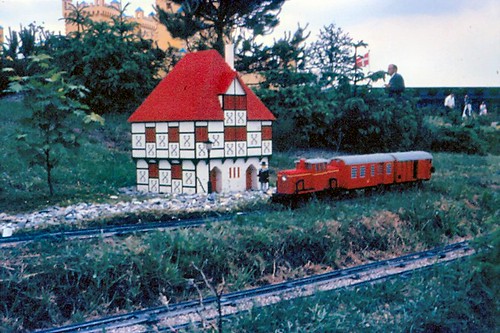
 Sometimes you come across things that completely take you by surprise. That's how I felt when I saw this collection of photographs of Legoland [Lego in general, for that matter] when it was in its infancy. It's hard to believe how far the brick has come since the 60's. Sometimes you come across things that completely take you by surprise. That's how I felt when I saw this collection of photographs of Legoland [Lego in general, for that matter] when it was in its infancy. It's hard to believe how far the brick has come since the 60's.
|
|
|


 and
and  of
of