Posted by
Dan
at
7:43 PM
| Name of Model: Happy Valentine's Day |
| Created by: Schneider Chung ("Schfio") |
| Found at: https://www.flickr.com/photos/schfio/32898475325/ |
Details:  Ladies and gentlemen, we have a winner. This is the most adorable thing you will see this Valentine's Day. The characters here are Fabuland figures - but here, the original Elton Elephant and Bonnie Bunny are only used as "gifts" that the larger, sculpted versions of the characters are giving each other. Ladies and gentlemen, we have a winner. This is the most adorable thing you will see this Valentine's Day. The characters here are Fabuland figures - but here, the original Elton Elephant and Bonnie Bunny are only used as "gifts" that the larger, sculpted versions of the characters are giving each other.
As cute as Elton and Bonnie are, the details of this model only make it more captivating. Note that the arms get thicker further away from the body to capture the curvature correctly - the "top" of each arm (actually built sideways) is made from rows of headlight bricks with 1 x 1 tiles connected to their fronts. The curved effect this creates is subtle, but an excellent use of the half-plate-thick offset you can get from a headlight brick. Clip plates hold the bunny's eyes in place and also form her eyelashes. Plates with rails fill some (roughly) half-stud-wide spaces that otherwise wouldn't look as round. The elephant's ears even achieve the difficult "cupped" effect by carefully weaving plates together in different directions - and I still can't tell how his eyes are attached. Bonnie's mouth is exquisite - a minifig cap sits on top of a precise jumper plate construction that conceals part of a set of whiskers built as a studs-up mosaic.
Schneider Chung hadn't posted on Flickr for a while before this, but he remains one of the best at building in his signature studs-not-on-top style. I highly recommend that you explore the rest of his photostream. We've previously featured a few of his adorable Easter-themed animals.
|
|
Posted by
Dan
at
1:00 AM
| Name of Model: Up to no good. |
| Created by: Ryan McNaught (The BrickMan) |
| Found at: https://www.flickr.com/photos/ryanmcnaught/17403430781/ |
Details: 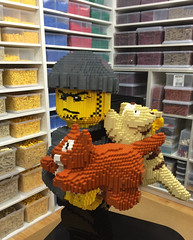 Minifig sculptures are an interesting genre - you can build them at so many different scales, and with so many different techniques, but it still seems like most people just copy set 3723. Increasingly, the official sculptures that LEGO uses for promotional purposes seem to be getting increasingly cartoony, with dimensions and angles that look less like actual LEGO pieces and more like something out of a LEGO-branded video game. It's an interesting aesthetic that I suspect we'll see leaking into fan-created builds over time, but so far seems to be used primarily by professionals. Minifig sculptures are an interesting genre - you can build them at so many different scales, and with so many different techniques, but it still seems like most people just copy set 3723. Increasingly, the official sculptures that LEGO uses for promotional purposes seem to be getting increasingly cartoony, with dimensions and angles that look less like actual LEGO pieces and more like something out of a LEGO-branded video game. It's an interesting aesthetic that I suspect we'll see leaking into fan-created builds over time, but so far seems to be used primarily by professionals.
One advantage of Ryan McNaught's status as a LEGO Certified Professional in Australia is that his model shop is LEGO's preferred method of making official promotional sculptures in Australia (this doesn't happen in most of the world, but it's an advantage of being on a continent without other model shops or certified professionals). Because of this, official designs for sculpted large minifigures have been trickling out on Ryan's Flickr photostream for some time now. They're not all necessarily built or designed by Ryan, but they're all built in his studio. You can see a few more characters under his legominifig tag and legocity tag, or, say, in any of these photos. There aren't too many photos of any particular model, but the models themselves are nice, with appropriate details and sculptural technique. It's worth taking a look and browsing through his photostream.
|
|
Posted by
Dan
at
11:07 PM
| Name of Model: Nnenn: Never to be forgotten |
| Created by: jamesuniverse |
| Found at: https://www.flickr.com/photos/jamesuniverse/17013314661/ |
Details: 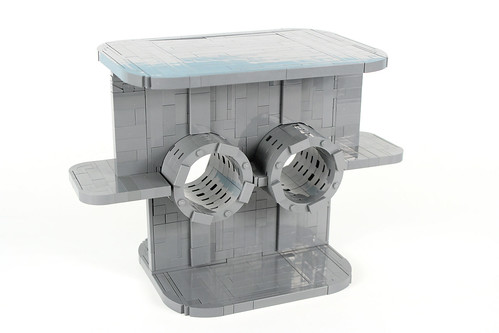 The latest addition to the exciting world of scaled-up LEGO elements made out of standard LEGO elements is this incredible rendition of the classic rubber band holder, a much-derided "useless part" that was seemingly inescapable in sets for about a decade. This particular build is about 8 times the regular size of the part, and makes great use of the 4x4 macaroni element to portray the Technic pin holes in the part. I'm also enjoying the use of curved-top arches and 1x3 curved slopes to capture the curvature at the edges of the part. The latest addition to the exciting world of scaled-up LEGO elements made out of standard LEGO elements is this incredible rendition of the classic rubber band holder, a much-derided "useless part" that was seemingly inescapable in sets for about a decade. This particular build is about 8 times the regular size of the part, and makes great use of the 4x4 macaroni element to portray the Technic pin holes in the part. I'm also enjoying the use of curved-top arches and 1x3 curved slopes to capture the curvature at the edges of the part.
What elevated this part to a more beloved status was a joke by one LEGO fan about how "cool" LEGO pieces don't get named after builders who use them frequently anymore. Surely the LEGO fan community has been around too long and we'll never name a great piece after someone who used it well again. Nate "nnenn" Nielson figured that if a piece were named after him, it would be something like this rubber band holder (unfortunately, variations on this story have been told so many times in tribute to the man that it seems to no longer be possible to find his original quote in a quick search of the web). After Nnenn passed away, the decision to refer to this part as a "nnenn" was unanimous.
The title and description offered on Flickr for this model make it clear that this was intended as a tribute to nnenn (the man, not the part). The definitive (and most detailed) current tribute can be found at The Brothers Brick.
|
|
Posted by
Dan
at
1:11 AM
| Name of Model: Tux |
| Created by: Steffen "Asperka" Rau |
| Found at: https://www.flickr.com/photos/66636161@N00/sets/72157646874722554 |
Details:  I've recently written about the increasing popularity of building sculptures with studs facing out in all directions. It allows for a stunning level of precision in a model, making it pop with realism. This one's a bit different than most of the others I've blogged in the past, though: most of the shape of this model was generated by a computer. LSculpt has been around for a while, but for us LEGO Open Source junkies (I know I'm not the only one), it's exciting to see it used to make RepRap's version of the iconic Linux mascot, Tux the penguin, exist in the brick. Sure, sure, it's not that difficult to build a model from computer-generated instructions, but it's no mean feat to track down all the right pieces for a model on this scale (50 cm/63 studs/20 inches tall), and most of standing out in the LEGO community is more about having good ideas for what to build than about how clever you are with LEGO techniques anyway. It's hard to overstate the cleverness of the complete Free Open Source Software chain here - a Linux penguin, colored in GIMP, modeled in Blender, run through LSculpt. I've recently written about the increasing popularity of building sculptures with studs facing out in all directions. It allows for a stunning level of precision in a model, making it pop with realism. This one's a bit different than most of the others I've blogged in the past, though: most of the shape of this model was generated by a computer. LSculpt has been around for a while, but for us LEGO Open Source junkies (I know I'm not the only one), it's exciting to see it used to make RepRap's version of the iconic Linux mascot, Tux the penguin, exist in the brick. Sure, sure, it's not that difficult to build a model from computer-generated instructions, but it's no mean feat to track down all the right pieces for a model on this scale (50 cm/63 studs/20 inches tall), and most of standing out in the LEGO community is more about having good ideas for what to build than about how clever you are with LEGO techniques anyway. It's hard to overstate the cleverness of the complete Free Open Source Software chain here - a Linux penguin, colored in GIMP, modeled in Blender, run through LSculpt.
There's also that nose - zoom in on the photos and you can see that care was put in to use tiles to round things out just a little more than LSculpt suggested. You'd be surprised how often small details like that end up being what separates a builder who really knows what he/she is doing from someone who is building directly from a program.
Also adorable: this comparison shot with other versions of Tux, and this close-up of a version of Tux scaled to Mixel eyes.
It's also noteworthy for historical reasons (and comparison's sake) that Eric Harshbarger (in many ways the first big freelance LEGO sculptor) has built Tux in a more traditional studs-up style, without the aid of modern programs or techniques. Newer tools and tricks have a way of making awesome models seem less exciting in retrospect (as they say, nostalgia isn't what it used to be).
|
|
Posted by
Dan
at
1:49 PM
| Name of Model: A Box of Milk |
| Created by: Kosmas Santosa |
| Found at: https://www.flickr.com/photos/kosmassantosa/15857546889/in/photostream/ |
Details: 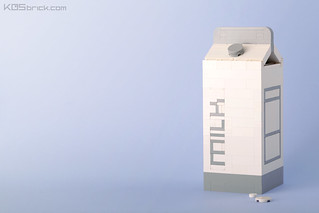 As part of the FOODcember 2014 building challenge, Kosmas Santosa built this very realistic bottle of milk...and mini chocolate cake, a chocolate cake with cherry and cream on top, a martini, fried chicken and french fries, and a kitchen to establish the theme for the month. That's not even all of his builds for this challenge, and it's only small taste of the delicious models in the FOODcember Flickr pool. As part of the FOODcember 2014 building challenge, Kosmas Santosa built this very realistic bottle of milk...and mini chocolate cake, a chocolate cake with cherry and cream on top, a martini, fried chicken and french fries, and a kitchen to establish the theme for the month. That's not even all of his builds for this challenge, and it's only small taste of the delicious models in the FOODcember Flickr pool.
This model isn't terribly complex from a technical standpoint, but it features great uses of lettering, hinges, and studs-not-on-top building (check out the boxes shown on the side). Then, of course, there's the use of a 1 x 1 round tile and 2 x 2 round tile to represent some milk that has spilled.
|
|
Posted by
Dan
at
3:16 AM
| Name of Model: Baymax |
| Created by: lisqr |
| Found at: https://www.flickr.com/photos/43699326@N00/15801224498/ |
Details: 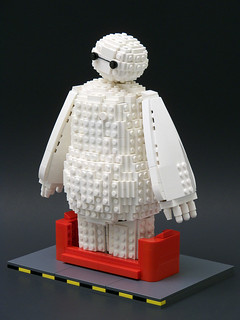 lisqr recently built Baymax as he appears in Disney's adaptation of Big Hero 6. The studs-out technique for building sculptures has gotten more popular lately - I still usually associate it with Schfio, one of the best builders currently working in that style, but it seems like everyone is trying their hand at it now that you can get travis bricks on the Pick-A-Brick wall at LEGO stores (and LEGO seems to be putting out more exciting studs-not-on-top elements in sets as well). Bruce Lowell is also rather famous for this style of building, and the head on this model is an obvious riff on his classic Lowell sphere (have I really not written about any of Bruce's models since 2007? Time flies). lisqr recently built Baymax as he appears in Disney's adaptation of Big Hero 6. The studs-out technique for building sculptures has gotten more popular lately - I still usually associate it with Schfio, one of the best builders currently working in that style, but it seems like everyone is trying their hand at it now that you can get travis bricks on the Pick-A-Brick wall at LEGO stores (and LEGO seems to be putting out more exciting studs-not-on-top elements in sets as well). Bruce Lowell is also rather famous for this style of building, and the head on this model is an obvious riff on his classic Lowell sphere (have I really not written about any of Bruce's models since 2007? Time flies).
The arms here are actually made from a great use of a different sculpture technique - loosely matching up various sizes of slopes and wedges. I believe I spy (please correct me if you think I'm wrong) a 2 x 1 curved slope, a 1 x 2 tile, and a 10 x 1 curved slope on each front edge, with a pair of 12 x 3 wedge slopes making the top and bottom of each arm. Even with all those slopes, it looks like the front and back edges are angled in further to get it to look just right.
...and I didn't even mention the great use of string on the robot's face yet.
|
|
Posted by
Dan
at
4:53 PM
| Name of Model: Sign of the Times: Failure of the Fourth Estate |
| Created by: Mike Doyle |
| Found at: http://mikedoylesnap.blogspot.com/2014/10/sign-of-times-failure-of-fourth-estate.html |
Details: 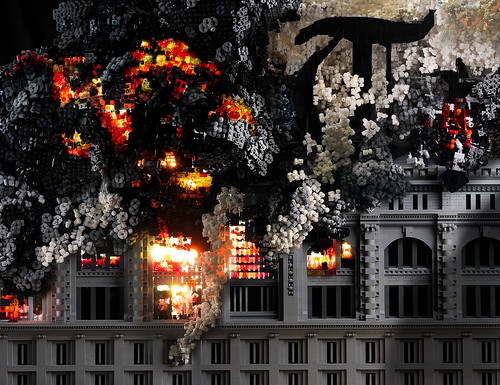 Mike Doyle has created another one of his signature artistic photos of an incredibly textured brick-built scene. This time, it's a poignant political statement about the state of mass media. Normally I'd be a bit hesitant to blog a political model here, but sadly, if you have even a passing knowledge of the LEGO world, you know that many media outlets find it extremely difficult to get even simple details right, like proper use of the name "LEGO" or terms like "LEGO bricks". It's a wonder that we trust the same outlets that very clearly can't cover simple matters fairly or accurately to give us the information we need about local, national, and world events. Mike Doyle has created another one of his signature artistic photos of an incredibly textured brick-built scene. This time, it's a poignant political statement about the state of mass media. Normally I'd be a bit hesitant to blog a political model here, but sadly, if you have even a passing knowledge of the LEGO world, you know that many media outlets find it extremely difficult to get even simple details right, like proper use of the name "LEGO" or terms like "LEGO bricks". It's a wonder that we trust the same outlets that very clearly can't cover simple matters fairly or accurately to give us the information we need about local, national, and world events.
That's before we get into the techniques used here - although Mike Doyle's models are only designed to be viewed from one angle, the craftsmanship involved is always top-notch. The backlit fire and smoke features some fascinating angles, most of which seem to be supported with plates with clip lights - which is not the sturdiest connection, so presumably something clever is used in the background to keep the smoke from falling over. Round plates (both 1x1 and 2x2) seem to handle most of the billowing smoke. The included part of the Times logo is a spot-on mix of various slope elements that works without any of the standard mosaic techniques. A visible piece of netting and some bar-and-clip elements hints at additional support for the smoke. The building itself looks a bit simple, but is very effective, making use of the undersides of plates, repetitive parts, and the 2:5 ratio (2 studs wide is the same distance as 5 plates tall - seen here in the window frames) to capture architectural details.
The use of color for the fire and windows may actually be the most noteworthy feature here - Mike Doyle has cultivated a very unique aesthetic based on heavy use of black and white, which makes the color here pop more than it usually would - and makes it all the more impressive that he already seems to have mastered mixing different translucent colors to get the fiery effect seen here.
In addition to reading about this model here and on Mike Doyle's blog, you can also see it on MOCpages and Flickr.
LMOTD previously covered Mike Doyle's Three Story Victorian with Tree, blog (update) and Two Story with Basement. We seem to have skipped his two books and other MOCs.
|
|
Posted by
Dan
at
1:00 AM
| Name of Model: Miniature Husky |
| Created by: Quy Chau |
| Found at: https://www.flickr.com/photos/nxtquy/sets/72157644934079871 |
Details: 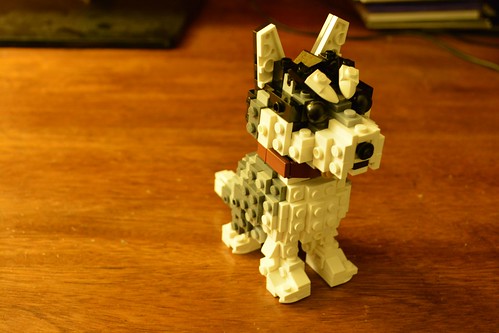 This is one of those rare models that is technically interesting, aesthetically pleasing, and documented in freely available instructions. While the availability of specific small pieces and studs-not-on-top elements has meant that most people can't easily attempt this style of building, the reality is that it can be quite tricky to get the geometry to work out just right - it isn't easy even with all the right pieces handy. Having instructions (for something more complex than a Lowell sphere) is a great place to start, and should get more people trying this out (even if only to build other dog breeds). This is one of those rare models that is technically interesting, aesthetically pleasing, and documented in freely available instructions. While the availability of specific small pieces and studs-not-on-top elements has meant that most people can't easily attempt this style of building, the reality is that it can be quite tricky to get the geometry to work out just right - it isn't easy even with all the right pieces handy. Having instructions (for something more complex than a Lowell sphere) is a great place to start, and should get more people trying this out (even if only to build other dog breeds).
There are some other nice details in the model as well. Note the use of 1x1 plates with teeth as claws and Bionicle ball joints as eyes. The "SNIR" (Studs-Not-In-a-Row) approach to the eyebrows is a clever way of filling in a gap that requires getting away from 90 degree angles, and a similar problem with the ears is solved by having them attached to Technic half-pins (which have a stud on one side and will allow anything attached to that stud to swing loosely). While a bit simpler, I'm a fan of the collar as well - it's a detail that makes the finished result more believable, and the studs-not-on-top geometry makes the cheese slopes look perfectly believable as a round surface. |
|
Posted by
Dan
at
8:07 PM
| Name of Model: LEGO Pop-up Todai-ji + Daibutsu (Buddhism) レゴで飛び出る東大寺 |
| Created by: talapz |
| Found at: |
| Details: You may remember the spectacular pop-up model of Kinkaku-ji (the Temple of the Golden Pavilion) from a few years back. More recently, the builder has made another excellent pop-up temple - Nara, Japan's Todai-ji. This one also includes the Daibutsu inside the temple. Around the 1:52 mark, the video switches from a demonstration to CAD-based building instructions, complete with part counts for each step. All 8,816 pieces are accounted for, and there's a complete parts list with BrickLink part numbers at the end. |
|
Posted by
Lego Obsessionist
at
2:31 PM
| Name of Model: 'Twas brillig, and the slithy toves... |
| Created by: Hans Dendauw NPD |
| Found at: http://www.mocpages.com/moc.php/338186 |
 Details: This creation pays tribute to Lewis Carroll's Details: This creation pays tribute to Lewis Carroll's classic poem with a brilliant MOC based on Tim Burton's Jabberwock. Not only does it capture the source material extremely well, it also uses fantastic parts usage and shaping to make a surprisingly complex MOC look sleek and whimsical. I highly suggest checking out the MOCpages page to fully appreciate the great design. This was made as part of a VirtuaLUG layout at Brickworld. It is also the most maxome creation I think I've ever seen. classic poem with a brilliant MOC based on Tim Burton's Jabberwock. Not only does it capture the source material extremely well, it also uses fantastic parts usage and shaping to make a surprisingly complex MOC look sleek and whimsical. I highly suggest checking out the MOCpages page to fully appreciate the great design. This was made as part of a VirtuaLUG layout at Brickworld. It is also the most maxome creation I think I've ever seen. |
|
Posted by
Dan
at
3:41 PM
| Name of Model: HAPPY EASTER DAY 2012 |
| Created by: Schfio |
| Found at: http://www.flickr.com/photos/schfio/6902015022/ |
Details:  The reigning champion of cutesy Easter models is back to one-up last year's impressive model. I do wish we could see a different angle of this bunny's face - the minifig helmets used for eyes look pretty good from this photo, but I'd love to see how it looks from the side. The egg cart is priceless, continuing the studs-out approach and even including wheels built out of plates instead of using regular wheel and tire parts. The best detail may be the necktie, though, making use of two red plates with clips attached sideways to get the double-sided plate effect - it's not a difficult technique, but most people wouldn't think to have made the middle of the bowtie sideways facing outward so that could work. The reigning champion of cutesy Easter models is back to one-up last year's impressive model. I do wish we could see a different angle of this bunny's face - the minifig helmets used for eyes look pretty good from this photo, but I'd love to see how it looks from the side. The egg cart is priceless, continuing the studs-out approach and even including wheels built out of plates instead of using regular wheel and tire parts. The best detail may be the necktie, though, making use of two red plates with clips attached sideways to get the double-sided plate effect - it's not a difficult technique, but most people wouldn't think to have made the middle of the bowtie sideways facing outward so that could work.
|
|
Posted by
Dan
at
11:42 PM
| Name of Model: Nerf_01 |
| Created by: Arkøv. |
| Found at: http://www.flickr.com/photos/arkov/tags/nerf/ |
Details:  Somewhere along the way, I started collecting Nerf Mavericks when I could find them on the cheap - used, I could find them for very little at some of the same places I was buying used LEGO. A coworker had started bringing some into the office, and I felt a need to have at least one of my own so I could shoot the dart back. The Maverick seems like the ideal model in my mind - it's a simple 6-shooter, fast enough for goofing off but not so fast that you're likely to end up with a giant pile of darts on the floor afterwards (admittedly, this is my own idealism, and another coworker has since proven just how quickly a mess can be made with a Maverick and a few hundred darts. Somewhere along the way, I started collecting Nerf Mavericks when I could find them on the cheap - used, I could find them for very little at some of the same places I was buying used LEGO. A coworker had started bringing some into the office, and I felt a need to have at least one of my own so I could shoot the dart back. The Maverick seems like the ideal model in my mind - it's a simple 6-shooter, fast enough for goofing off but not so fast that you're likely to end up with a giant pile of darts on the floor afterwards (admittedly, this is my own idealism, and another coworker has since proven just how quickly a mess can be made with a Maverick and a few hundred darts.
There are apparently quite a few people who have gotten into both LEGO and Nerf. Obviously, we've covered a NXT/Nerf robotic tank before, and there's at least one famous photo of a Nerf gun fight kick-off at a LEGO convention. It seems to go deeper than that - it's very common to see people asking on flickr what they should buy first - a Nerf gun or a particular LEGO set (spoiler: the correct answer is always the LEGO set).
Here, though, we see the logical conclusion of this convergence of crazes, the coupling of these commonly collected cool curios - a photorealistic LEGO version of the Nerf Maverick. The slide and barrel move just like the real thing, although it wasn't possible to have this much realism and make the internal mechanisms work at the same time (not that you'd get the correct effect from an official LEGO spring anyway). A few stickers had to be used, but it's hard to argue with that when this look is this exact. The size, complexity, and accuracy of this model sets a new standard for hyper-realistic life-size replicas of ordinary objects.
|
0
|
Posted by
Dan
at
11:16 PM
| Name of Model: Control Center |
| Created by: Brixe63 |
| Found at: http://www.flickr.com/photos/35385165@N05/tags/controlcenterii/ |
Details:  Back in 1995, LEGO released the (then-groundbreaking) Control Center II. As a "programmable" (through routines on a specialized console) tool for motorized Technic creations, it was a precursor to the more recent Mindstorms kits. One of the models you could build with the kit (the dinosaur) has been used as a flagship for the LEGO company long past when you could actually buy the Control Center II - giant sculptures of it can be found at LEGOLAND attractions. Here, we have life-size reproductions of some elements from the kit - the Control Center itself, and the European version of the power cable - alongside a 9V motor (a newer version than the one that came with the Control Center kits) and the end of a European extension cord. Back in 1995, LEGO released the (then-groundbreaking) Control Center II. As a "programmable" (through routines on a specialized console) tool for motorized Technic creations, it was a precursor to the more recent Mindstorms kits. One of the models you could build with the kit (the dinosaur) has been used as a flagship for the LEGO company long past when you could actually buy the Control Center II - giant sculptures of it can be found at LEGOLAND attractions. Here, we have life-size reproductions of some elements from the kit - the Control Center itself, and the European version of the power cable - alongside a 9V motor (a newer version than the one that came with the Control Center kits) and the end of a European extension cord. |
|
Posted by
Dan
at
9:36 PM
| Name of Model: Going to the movies? |
| Created by: The Slushey One (kyle slushey) |
| Found at: http://www.flickr.com/photos/kyle_slushey_is_awesome/5911253068/ |
Details:  This version of Luxo Jr This version of Luxo Jr (we swear, this is really a much-beloved Pixar character) may be one of the most complex "simple" objects we've ever seen. The high amount of detail shown here was made possible by using various parts with clips the size of minifig hands and bars that fit inside of those clips. They're not as well-known as the standard LEGO bricks, but they've been becoming increasingly common over the past several decades. By the 80's, we were seeing those sorts of parts used not just for minifig accessories, but in Space robots and in various lamp models. LEGO didn't really make this into much of a standard "system" until the past 10 years or so - the unexpected popularity of the lightsaber element made it practical to think of these as elements you can build with and not just decorative accessories. Suddenly, what started as a coincidence of common measurements has become a real system you can build realistic models out of. (we swear, this is really a much-beloved Pixar character) may be one of the most complex "simple" objects we've ever seen. The high amount of detail shown here was made possible by using various parts with clips the size of minifig hands and bars that fit inside of those clips. They're not as well-known as the standard LEGO bricks, but they've been becoming increasingly common over the past several decades. By the 80's, we were seeing those sorts of parts used not just for minifig accessories, but in Space robots and in various lamp models. LEGO didn't really make this into much of a standard "system" until the past 10 years or so - the unexpected popularity of the lightsaber element made it practical to think of these as elements you can build with and not just decorative accessories. Suddenly, what started as a coincidence of common measurements has become a real system you can build realistic models out of. |
|
Posted by
Lego Model of the Day
at
11:03 AM
| Name of Model: Star Wars Lego Artoo-Detoo R2-D2 |
| Created by: SPARKART! |
| Found at: http://www.flickr.com/photos/36161867@N08/sets/72157626425806979/ |
Details:  It's Star Wars day again (May the Fourth be with you! Yadda yadda yadda...), so here is a sculpture of R2-D2 on a classy black stand. I'm not really sure what the scale is on this sculpture (it's a bit large for most of the popular ones), but the details come across very well. Perhaps the scale was chosen so that the markings on R2-D2 would be close to full stud widths. The signature angled posture is captured here beautifully, but he can be stood up as well. It's not easy to use this many small slopes to make something appear this round - although steam engine builders have mastered the technique at a smaller scale, the effect doesn't tend to come out as smoothly there. It's Star Wars day again (May the Fourth be with you! Yadda yadda yadda...), so here is a sculpture of R2-D2 on a classy black stand. I'm not really sure what the scale is on this sculpture (it's a bit large for most of the popular ones), but the details come across very well. Perhaps the scale was chosen so that the markings on R2-D2 would be close to full stud widths. The signature angled posture is captured here beautifully, but he can be stood up as well. It's not easy to use this many small slopes to make something appear this round - although steam engine builders have mastered the technique at a smaller scale, the effect doesn't tend to come out as smoothly there. |
|
Posted by
Dan
at
11:00 PM
| Name of Model: Happy Easter 2011 |
| Created by: schfio |
| Found at: http://www.flickr.com/photos/schfio/sets/72157626422017053/ |
Details:  You may have heard that it was Easter this past weekend. For the occasion, this builder created this spectacular sculpture of a baby chick with easter eggs. Although the building-in-all-directions technique is still fairly novel (and frequently done with the aid of a computer), this builder has started making it a main part of his style and incorporated elements that can't easily be specified in a computer-generated design. Note how the little wings are attached by a clip instead of being sculpted on. The use of round eyes and a nose pushed between studs perpendicular to it are also great touches (which also serve to emphasize that this design is more than just a computer-generated pattern). You may have heard that it was Easter this past weekend. For the occasion, this builder created this spectacular sculpture of a baby chick with easter eggs. Although the building-in-all-directions technique is still fairly novel (and frequently done with the aid of a computer), this builder has started making it a main part of his style and incorporated elements that can't easily be specified in a computer-generated design. Note how the little wings are attached by a clip instead of being sculpted on. The use of round eyes and a nose pushed between studs perpendicular to it are also great touches (which also serve to emphasize that this design is more than just a computer-generated pattern). |
|
Posted by
Dan
at
11:54 PM
| Name of Model: It's My Birthday |
| Created by: powerpig (Chris McVeigh) |
| Found at: http://www.flickr.com/photos/powerpig/5610707006/ |
Details:  I've seen plenty of cakes over the years, but this one, erm, "takes the cake". The upside-down plates used in the middle make for a surprisingly believable cake-y texture. The frosting on the outside is similarly good use of texture - having studs face out in every direction captures the look better than tiles or the sides of bricks could. The 1x1 round plates (and the similar flowery element) make great sprinkles. I've seen plenty of cakes over the years, but this one, erm, "takes the cake". The upside-down plates used in the middle make for a surprisingly believable cake-y texture. The frosting on the outside is similarly good use of texture - having studs face out in every direction captures the look better than tiles or the sides of bricks could. The 1x1 round plates (and the similar flowery element) make great sprinkles. |
|
|
|