Details: Here's the start of a nice minifig-scale train layout - a shed and a signal house. I love the shed here - it's a very effective use of the "brick" brick element. This is a very classic use of the bricks and it works quite well. The simple ballast for the tracks is surprisingly convincing. I can't wait to see how the rest of the layout looks.
Details: The LEGO train community spends a considerable amount of time arguing about what the "correct" scale is for LEGO trains. Usually, 6-wide and 8-wide are the most popular options. The 6-wide crowd can point to most of the official LEGO train sets aimed at kids 6 and up, and the 8-wide crowd can (but rarely does) point to the DUPLO train sets. Here, we have evidence that you can capture the correct level of detail in trains that are only 2 studs wide. The realistic liveries and shapes come across nicely, and the small scale almost seems more forgiving (since nobody's going to complain about a misplaced air vent at this scale). The obvious question is when the rest of the trains will show up, but it looks like there's already a good start.
Details: Here's a new take on the Maersk set released recently - a wider version in a different color. Unless you see them side-by-side, it can often be difficult to tell the difference between Maersk blue and medium blue - which can be used to your advantage if you want to use a wider variety of parts to get the exact look you want. In this case, the issue was size. The builder is very passionate about scale. "Minifig scale" is an inherently nebulous concept, and LEGO's habit of throwing minifigs into things at wildly different sizes makes it even murkier. Having decided that 8 studs wide is appropriate for a train, the next challenge was to work out the details (such as the brick-built lettering on the sides). Many of them are essentially unchanged from the design in the set, but elsewhere - such as on the windows - things look much better.
My apologies about the gap in lately - it's been a rough few weeks for me personally (a death in the family) and I haven't been able to make blogging a priority. We're trying to get back up to speed now. I won't be making up the missing posts.
Details:
I'm still pretty exhausted after a long, strenuous weekend at LEGOPalooza. I stepped up to coordinate the town & train layout, and pretty much everything that could go wrong did - the final result came out well, but I was surprised we managed to pull it off at all. Since I already wrote up a proper round-up on the NCLUG (North Carolina LEGO Users Group) website and would rather not have to keep track of this in two places, I'm going to direct you there for photos and coverage of the event.
Details: So a few weeks ago, we were hamming it up by featuring a model of a Maersk train while other LEGO blogs were leaking images of what appeared to be some sort of official set with a similar theme. That set became official back on February 19th and looks really neat - here are the details from LEGO (they also have more photos at the link above):
10219 Maersk Train
Ages 14+. 1,234 pieces.
US $119.99 CA $159.99 DE 119.99 € UK 91.99 £
The highly-realistic Maersk diesel-electric freight train has arrived! A replica of the real engine that operated on the railroads of America, this Maersk train features exceptional detailing and functions, such as opening driver’s cab, removable side panel revealing a detailed, 16-cylinder engine, and authentic Maersk branding. The model also includes 2 wagons and 3 containers with opening doors (1 with refrigeration detailing). The set also includes a shunter truck and detachable trailer for loading and offloading the containers. Add LEGO® Power Functions accessories to motorize!
• Includes 3 workman minifigures!
• Train measures 36″ (92cm) long!
• Building instructions include a historical description of the LEGO Group/A.P. Moller Maersk Group cooperation and a timeline of the products launched!
• Containers can be loaded side-by-side or stacked!
• Motorize your Maersk train by adding LEGO Power Functions 8878 Power Functions Rechargeable Battery Box, #8887 Transformer 10V DC, #8884 Power Functions IR Receiver, 8879 Power Functions IR Speed Remote Control and 88002 Power Functions Train Motor!
Details: Last weekend, scurrilous rumors flittered about the LEGO-interested parts of the internet after someone found some leaked photos. Rest assured - if you see a post about a new set here, we've already verified that there really will be a new set out and will only post official announcements before the kit is actually released. Now, for something completely different (that just coincidentally sounds very similar):
This Maersk train locomotive was created by misterzumbi before he became a designer for the LEGO company. This actually could never be a set - the sheer size of it would rule it out. There's some argument in the LEGO train community over what the proper size of trains should be (mostly because "minifig scale" is a wildly inconsistent "scale"), but the official kits are almost always 6 studs wide. This one weighs in at 8 studs wide and 59 studs long. This is packed with great details, but the brick-built lettering on the sides.
Details: If you've really waded through all of the thousands of photos from this past year's Brickfair, you've seen this beauty before. Had any part of this model been registered on its own instead of as part of the PennLUG town/train layout, it would have won one of the convention's awards. There's too much here to do an in-depth look at the details fairly, and it's connected to the rest of the layout in a way that makes it difficult to tell where various people's contributions start and end. A few striking things should not be missed: the large amounts of shipping containers, the enormous dark blue boat, the trans-green water (built with tiles in something of a mosaic style), the docks, the cranes. This was so much of a show-stopper that you could be forgiven for not knowing that the PennLUG is generally more well known for trains!
Details: This is a 9V train, coming in at an intimidating 12 studs wide (most sets are 6-wide, and that "scale" remains popular with hobbyists as well. It's also a fantastic dragon with some great colors. Lime isn't always the easiest color to work with, but this sort of thing is what that color is made for (there are some other great uses of color here as well, but I'll let you find them yourself). There's also an impressive amount of clever angles in here - this photo of the head/locomotive alone shows several great tilted sections that blend together nicely for an organic look.
This is one of Megan Rothrock's older creations. She's since gone on to work on set designs for the LEGO company and write regularly for BrickJournal magazine. Short of becoming a collectible minifig, that's as close as you can get to being a rock star in the LEGO world.
Name of Model: Hogsmeade Station (these links go to all of this builder's Harry Potter creations, but a Brickshelf Gallery with more photos of this model will be available soon)
Details: There are a dedicated few Harry Potter fanatics who have been building Harry Potter based LEGO models even when no official sets in that theme have been released (they are now reviving the line). While I'm specifically focusing on this fantastic train station, based on Hogsmeade Station, most of the links actually point to the builder's full assortment of Harry Potter-based creations. When re-creating scenes and places from a franchise that has been shown in multiple formats, one of the big issues is deciding which version to build. LEGO recently decided in one of their new kits, The Burrow, that they're tying their version of things to the movies instead of the books. In the case of this model, we're actually seeing a version of the train station that doesn't match the movies, video games, or books - it's an "upgraded" version of the building from after the Harry Potter stories. I guess that means this is technically a Harry Potter "fanfic" model - which I'll allow on the grounds that it's an awesome model. The landscaping, architectural details, and even the minifig posing all comes across as extremely realistic. While this a good example of keeping flashy techniques from getting in the way of a good design, the rear features a footbridge with some fantastic angled sections that only enhance the overall look.
Details: Recently, QuéLUG put on a show at ExpoRail. This two-day show at the Canadian Railway Museum appears to have been a great success. The theme this year was "coastal town" and the group worked together to combine many great models into this spectacular layout.
There are 287 photos to see in the official flickr photoset.
Details: Here's something I built. It's actually my first true Bionicle creation. I had gotten in the habit of buying used Bionicle sets for the Technic bits and the occasional part that wound up having broader usefulness. What started as a curiosity as to what could be done with these parts turned into inspiration when I saw the large curved panels that started showing up in vehicles in the 2009 line. They looked like they'd make great steam engine boilers in a few different sizes! Before long, I was combining Bionicle parts with some wheels from an Emerald Night set to create this unusual steam engine. It's not terribly practical - you generally want your engine to be heavy to increase traction, and this is extremely light - but it is drivable. The biggest lesson learned here is that building with Bionicle parts is way more fun than it looks. It's actually pretty thrilling when you see those "weird" and "useless" parts actually line up in a meaningful way.
This model will be on display at Brickfair 2010, which is open to the public on August 7th & 8th, 2010 from 11:00 AM - 4:00 PM.
Details: I would write more about this GBC, but I'm still spending time studying it. The video quality is a bit lacking, but the modules in this one are spectacular. Lots of brilliant stuff here - pneumatics, Mindstorms, trains (the train is controlled via RCX to stop and start in the right places to load/unload), an all-around great variety of both classic and very original sorts of mechanisms. There are even Spacewarp-style sections with loop-de-loops, a base 5 ball counter, and color-sensitive sorters to tell the basketballs and soccer balls apart. I'm not sure exactly where this layout was setup or how many people participated in constructing it, but I'm suitably impressed with all involved.
Details: This is a fairly surprising model. At first glance, you can't really tell what's going on. It's a reasonably realistic model of a subway station. Except that it's not just an underground station - it's actually lit up, and the train itself is a functional 9V train. It looks like the lights are actually bright enough that no other lights were used for these photos (needless to say, I'm assuming that these are not LEGO lights and are actually just wedged into LEGO pieces, by either modification of the lights, of the bricks, or both). Of the five photos here, two are inspiration photos that show how close of a likeness this is to the original. Even the signs and advertisements are replicated in LEGO form.
Details: The Pennybacker "360" Bridge in Austin, Texas, was re-created in LEGO form for this year's SXSW festival (more coverage of that coming Sunday - we're highlighting this one model separately today). A few minor modifications were made to the original design to make it fit a minifig-scale town layout better - the roadway was flattened, train track was added, and the asymmetric parts of the bridge were made symmetrical. This actually features a complete Technic support frame - a few thousand Technic half-pins were used to attach the dark red plates on top of the structure. The link above has all the information you need on this model, including photos of the model's construction and of the life-size bridge in Austin that this is based on. Here are some basic stats (for those of you not yet convinced):
Model Specs and Facts:
Start date: 31-January-2010
Date of completion: 13-March-2010
Nearly 14,000 pieces used
35-40 pounds in weight (estimated)
Total bridge length = 384 studs (aprox. 120 7/8 inches = 3.1 m)
Details: Seeing that we covered a rendition of the Metroliner set in monorail form, we would be remiss if we did not mention a similar rendition of the Emerald Night. There are few real flagships in the Trains series, with the high raw costs of the sets (if you think in terms of price-per-part and factor in comparable other trains, they're usually inexpensive, but that's not immediately apparent) frequently scaring off even most people who are impressed by the designs, but both the Metroliner and the Emerald Night stand out as important classics. The Metroliner was in the first round of 9V system kits, and looked snazzy with its Amtrak color scheme (slightly more European stylings elsewhere made it a tough sell to some serious train fans, but it was decidedly more realistic than other 1990's LEGO train kits). The Emerald Night is the first train kit to feature the new steam locomotive wheels, and the options for motorizing it introduce the new Power Functions system.
Which is why the both warrant microscale tributes, but doesn't say too much about this little version (I'd like to see you try writing this many words about other people's LEGO creations every day and not getting a little off-topic). This is a simple and elegant build that mimics the features of the original set fairly closely.
Browsing through Brickshelf today, I found some photographs of an event that took place in Switzerland. While I really don't have much to say about this at all, I do suggest you take a look at some of the other photos from this event.
They've [people who put this show on] got some great ideas that could add to any persons layout or creation.
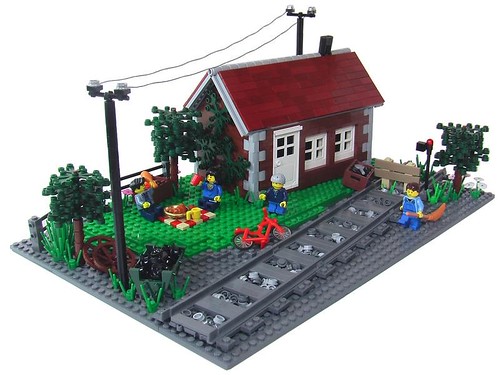
Details: "Legoadam" has created a lovely train scene, depicting a rural railhead.
This creation has many aspects that are appealing to me, but the part of this creation that draws me the most is the angled track that has been tiled over in places with light/dark bley1x1 plates placed around it to mimic ballast.
The structure seen here is exceptional in its own right. It has been constructed by stacking brown plates -- yes, plates. That's devotion, if you ask me. The half stud offsets and use of the new style of doors just adds even more to this structure, still. Another area of the structure that demands a closer inspection is the roof. It appears to be made out of plates and tiles. The roof rests (it may be further secured, hard to tell) at an angle on the walls of the structure, gaps are not present due to the use of the every useful cheese slope.
The landscaping seen here is also commendable, as is the figure placement.
A well put together creation, with a clean, coherent appearance.
Details:
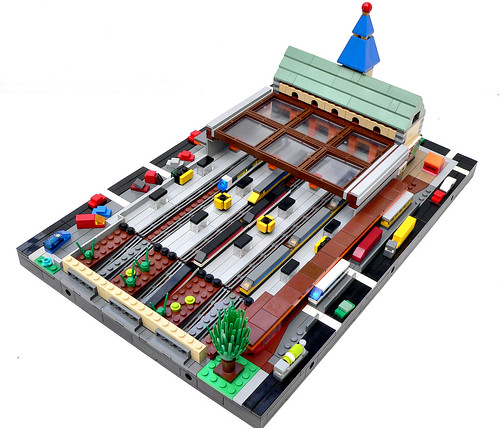
Erik Smit just can't seem to stop building amazing creations. Over that past couple of weeks everything that he has churned out has been exceptional. His most recent creation built in the "micropolis standard" is no exception.
I was really taken aback with this model. You look at it the first time, notice a lot of things. Look at it a second time, notice some more minor details. Then you look at it a third time, and you notice things that make you (or me at least) say "oh wow" out loud.
One of the great things about Erik's creations is that they all incorporate a mixture of very new parts and older parts. This is evident with his use of cheese slopes, a part which first appeared in 2004, and trans clear macaroni bricks, which first appeared in the 1950's.
Another aspect of the creation that I really enjoy is the fact that the trains submerge after leaving the station. This is great seeing that with a micropolis layout being collaborative, this "module" can hold its own and does not require other modules to have track to achieve an overall coherent appearance.
Just a wonderful, wonderful piece of work. I've been inspired.
Details:
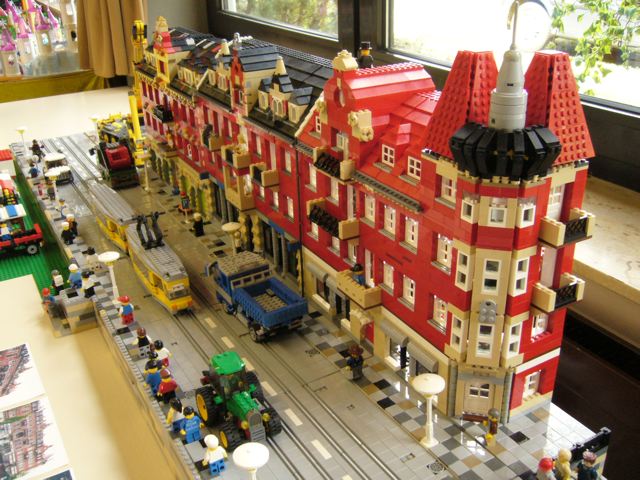
This is a remarkably realistic looking creation, despite the use of primary colors.
I was most impressed with the "tram tracks" being integrated into the street. This is done in many town layouts, however this one was carried out particularlly well.

 Here's the start of a nice minifig-scale train layout - a shed and a signal house. I love the shed here - it's a very effective use of the "brick" brick element. This is a very classic use of the bricks and it works quite well. The simple ballast for the tracks is surprisingly convincing. I can't wait to see how the rest of the layout looks.


 fanatics who have been building Harry Potter based LEGO models even when no official sets in that theme have been released (

 -style sections with loop-de-loops, a base 5 ball counter, and color-sensitive sorters to tell the basketballs and soccer balls apart. I'm not sure exactly where this layout was setup or how many people participated in constructing it, but I'm suitably impressed with all involved.