Details: Duncan "donuts_ftw" Lindbo recently came across the Buzz Lightyear wing element from the Disney series of Collectible Minifigures and built this beauty. This microscale version of the X-Wing Fighter (from Star Wars, now also owned by Disney) also makes great use of the new Flat Tile 1X1 ½ Circle, White element (found in a few Mixels sets) to get the shaping of the wings right at this scale. There's also some clever studs-not-on-top (SNOT) work - note the lime clip ring plate in the cockpit to connect the two 1x1 plate with tooth elements on the sides. Notice that (although I'm not sure how he did it - perhaps white clip ring plates attached to either side of the lime one?) the bottom set of wings is attached upside-down relative to the cockpit and top set of wings - a nice bit of symmetry that keeps the handle bar plates from marring the shape of the spaceship.
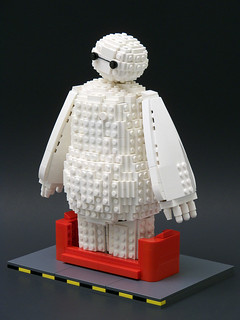
Details: lisqr recently built Baymax as he appears in Disney's adaptation of Big Hero 6. The studs-out technique for building sculptures has gotten more popular lately - I still usually associate it with Schfio, one of the best builders currently working in that style, but it seems like everyone is trying their hand at it now that you can get travis bricks on the Pick-A-Brick wall at LEGO stores (and LEGO seems to be putting out more exciting studs-not-on-top elements in sets as well). Bruce Lowell is also rather famous for this style of building, and the head on this model is an obvious riff on his classic Lowell sphere (have I really not written about any of Bruce's models since 2007? Time flies).
The arms here are actually made from a great use of a different sculpture technique - loosely matching up various sizes of slopes and wedges. I believe I spy (please correct me if you think I'm wrong) a 2 x 1 curved slope, a 1 x 2 tile, and a 10 x 1 curved slope on each front edge, with a pairof 12 x 3 wedge slopes making the top and bottom of each arm. Even with all those slopes, it looks like the front and back edges are angled in further to get it to look just right.
...and I didn't even mention the great use of string on the robot's face yet.
Details: This version of Luxo Jr (we swear, this is really a much-beloved Pixar character) may be one of the most complex "simple" objects we've ever seen. The high amount of detail shown here was made possible by using various parts with clips the size of minifig hands and bars that fit inside of those clips. They're not as well-known as the standard LEGO bricks, but they've been becoming increasingly common over the past several decades. By the 80's, we were seeing those sorts of parts used not just for minifig accessories, but in Space robots and in various lamp models. LEGO didn't really make this into much of a standard "system" until the past 10 years or so - the unexpected popularity of the lightsaber element made it practical to think of these as elements you can build with and not just decorative accessories. Suddenly, what started as a coincidence of common measurements has become a real system you can build realistic models out of.
Details: It feels a little strange to throw that "(Unofficial)" up there in this post's title. After all, it's already been announced that LEGO is doing an official line of Pirates of the Caribbean series, and LEGOLAND parks have featured characters (both officially licensed and otherwise) in miniland for years. It's surely only a matter of time before these Disney pirates wiggle their way in to the official LEGO miniland displays. The master model builders who create those for the company will have a hard time competing with the rendition of Captain Jack Sparrow and Captain Barbossa pictured here. I suspect that they won't be allowed to use a Technic rubber band to properly define the edges of a hat. The angle work on the torsos is stunning and a bit unexpected - usually you see a few slopes used when that is tried, but here we see tiles and plates attached at odd angles. On Jack Sparrow, the space created by the angle leaves room for minifig hands to clip onto a plate-with-railing in front of them. We see similar clips used in a few other places - the Jack's hair and hands use variations on the same technique. The legs on both figures look great, but use the same sort of non-production parts that are occasionally special-made for the LEGOLAND Model shops (existing parts, but in colors you can't find in a set). On second thought, are we sure that this guy DOESN'T work for the company?
Details: It's a real shame that LEGO has been phasing out chrome-colored elements recently. Sure, the process of manufacturing those parts is expensive, but the effect is fantastic. Just a few short years ago, you could get the UCS Naboo Starfighter, which came with tons of chrome silver elements - including the wings you see used so well here. The metallic silver color we see instead isn't all bad, but it just doesn't have that reflective sheen that you need when trying to build mirrors. This magic mirror (think Snow White) looks stunning.
Details: Disney's Mickey Mouse in fully articulated form might not seem like an easy thing to build - but this design came quickly after the builder realized that a round ball could easily be turned into Mickey's head. There are some great techniques here - the legs connect to the torso by use of Bionicle ball-and-socket joints (good thing that the Technic ball joint element is actually made in red!), the mouth is made from a flower, and the thumbs are made from signal paddles. It helps that Mickey is one of the few characters with wiry enough limbs that the tentacle-like click hinge elements actually suit him well. Perhaps the best detail, though, is the rather mundane use of two tan 2x2 round plates near the top of his head - they perfectly capture the iconic "windows' peak" look of Mickey's face.
Details: Once again, time for the "obligatory cool thing everyone is talking about" - sorry if you've already seen it. This time, it's an enormous diorama of Andy's room from the Toy Story movies. The full view is shocking, although it takes a minute to get a grasp on the sheer size of this thing. The room is large enough that the minifigs of the toys are roughly in scale to be the size of Andy's toys in the movies. Normally I'd go through a bunch of interesting techniques in the model, but in this case a few of them are a bit fiddly and not something to recommend trying. The bed, for example, has several elements that are only attached in one place and aren't sturdy - the top of the footboard and headboard are both only attached to the center pole of each. Using the printed LEGO Nintendo DS cover mosaics as posters was an inspired choice, and the brick-built mosaic on the bedspread is a great touch. Most of the furniture looks pretty great, and the shelves of other toys really sell the scene - the full set of 30 photos is well worth a look.
Details: Walt Disney World's annual Festival of the Masters event is usually LEGO-heavy, with GFLUG well-represented and a build event at their LEGO Imagination Center. This year's event this past weekend was no exception.
Details: As seen in Zwolle recently, there is a new LEGO Mindstorms NXT-based version of Wall-E. This version tries to be strictly purist and true to the NXT system - not only does this not use any third-party robotics components, but this doesn't even use Power Functions motors (unlike the first great Wall-E we covered)! 8 NXT motors and 3 NXT programmable bricks were crammed in here to get this realistic and surprisingly expressive range of motion. While it doesn't transform, it seems to have every other Wall-E behavior down. Color sensors were even used to allow his eyes to light up in different colors. Don't miss the second link above, which has some photos of the internal mechanisms.
Details: A little green man needs a flying saucer. As far as I know, the little green men from Toy Story don't really have flying saucers, but this design seems like it would be perfect. From above, it looks like a claw picking up the alien, just like in the movie. The skid plates on the rim (not to mention the Robo-Attack cockpit) give this a charming retro-futurist look. Then there's the technique for making this round - although it's just a simple click-hinge approach, this is one of those rare places where that actually looks good. The gaps between the 16 sides add a believable amount of texture to the ship - and the sections actually come close enough together by the cockpit. Since the cockpit appears to actually be closed, it's believable that this could contain an atmosphere for the alien to breathe while he's travelling in space. I know that LEGO doesn't prioritize that in official sets, but it really is a sign of a spaceship designed to travel (open cockpit vessels just can't get you that far - no matter how good your classic space air tanks are).
On a related note, the builder also has compiled a buyer's guide for use in keeping track of set prices and price-per-part. My printout of it comes in handy when browsing in places that sell LEGO sets for above the regular price (yes, I know there's an app for that, but some of us are too cheap for that - and for us, the buyer's guide is a godsend).
Details: A simple tip for making mosaics look decent color-wise is to try using cartoons and other brightly-colored imagery as your source material. If something already uses bright primary colors, it'll be easier to build it with parts you actually have on hand (while not losing too much of the image quality). Naturally, this makes "Mickey Salutes America" look pretty great in LEGO form.
Details: Remember those scenes in Wall-E when the robotic protagonist adorably "transformed" into a little box? They've now been captured in LEGO form. How, exactly, the 3 NXT motor outputs were multiplexed into 5 9V motors, I don't know, but I think we can agree that the final effect is fantastic. One motor for each set of treads drives Wall-E around, while the other motors handle the head and arms. The process for folding the treads underneath is particularly great - three worm gears in series drive a system that actually changes the placement of the sprockets for the treads on the way underneath. Making that process one smooth mechanism is no small feat, but it works very well and adds a surprising amount of realism to this Wall-E. What makes this trickery with the tracks so realistic is that cutting-edge rescue robots that need to travel over rubble today. Being able to move the treads closer together like this allows a robot to turn around in a smaller amount of space - making it easier to navigate unpredictable terrain.
Figures that I can't find a good link to a non-LEGO robot that does that uses just two sets of treads and changes its steering geometry now, doesn't it?
2010 is finally here, and that means that the new sets that have been slowly dripping into select stores should now be showing up everywhere. All the new items should now be available from Shop at Home, including one new exclusive (with apologies to my international visitors, all the prices below are in US dollars).
First, the LEGO direct exclusive (available from S@H and LEGO brand retail stores) - the beautiful upgrade for the Imperial Guards' Imperial Flagship:
(#10210, $179.99, 1664 pieces, 9 minifigs)
When the original Imperial Flagship kit came out in 1992, it was a nice kit but it was hardly the size you'd expect a true Flagship (in naval terms, not LEGO ones) to be. This kit might still look a bit small for ship aficionados, but the upgrade in size is worthwhile, the looks are great, the parts are excellent (and exclusive in some cases), and the price is pretty decent as Pirate sets go - 1664 pieces for $180.
Other highlights of this wave of new 2010 kits include: Space Police Raid VPR:
(#5981, $9.99, 69 pieces, 2 minifigs)
An interesting development in the Space Police plotline, and the first clear connection between the original 1989 line and the current series. The alien's torso has both a double-printed Blacktron torso and Blacktron 2 logo. The officer in the set finally has a fully closed helmet, and even has a trans-red visor (which they haven't made SINCE the 1989 line). This set's a tad expensive, but the incredible new minifigs justify it (and make me wonder if we'll see more of a storyline develop - when did the Blacktron begin fraternizing with alieans?)
Woody's Roundup:
(#7594, $49.99, 502 pieces, 3 minifigs (4 if you count the new Toy Story horse))
The Toy Story line LEGO is releasing (thanks to their new licensing deal with Disney and Pixar) is off to an interesting start. Some of the sets are a bit expensive, but this one's right at the mark and includes quite a few rare pieces. The new character minifigs are very unique - we have hats permanently attached to heads, a new longer leg length, and even a new longer arm length. It seems like the best way to get LEGO to make a new part is to get a large licensing company to insist LEGO start making it - the Star Wars line had previously brought us new parts and colors, and the Toy Story line is already proving itself similarly fruitful. Additionally, this is the first new "Wild West" style kit we have seen since the late 1990's Wild West playtheme.
Tractor with Log Loader:
(#8049, $59.99, 525 pieces)
When the linear actuator component was unveiled a few years back, many of us Technic fans feared that this meant the end of the pneumatic system. As it was, we hadn't seen a new pneumatic kit in years and some parts (such as the air tank) were becoming quite hard to find (and expensive online). Last year saw their return to the Educational line, but this kit is the first to be available to the general market. As an added bonus, we finally get a new tractor design (last year's tractor kit was based on an older design, but in a new color), and (according to TechnicBricks' review) there's even parts and instructions included for building a motorized compressor.
Gateway of the Squid:
(#8061, $39.99, 354 pieces, 3 minifigs)
The Atlantis line is the big new playtheme this time out. It's a bit more exotic (and generally expensive) than the Power Miners series last year (which, by the way, is still around and will have additional new releases later this year) but it's turning out to be surprisingly interesting. New molded minifig parts abound, as do various earth-toned bricks and new elements. It's nice to see a new underwater line - they've tried several over the years - and the weirdness of some new elements and the mysterious new discs (which can open a gate in this set) are very appealing.
Finally, I wanted to spotlight one of the new Creator sets. The Creator sets continue to be the best values for the money, giving you plenty of special pieces and common bricks alike at a price lower than 10 cents per element. This one is just my personal favorite (I guess at some level these all are - you should really browse the full selection of sets yourself) - once again the Creator line features nothing but winning sets.
Apple Tree House:
(#5891, $44.99, 539 pieces)
A charming house with dark blue roof bricks and tan window frames. Sure, there are other nice features, but with those parts and that price-per-part ratio, aren't you already interested in one of these? The house may be a bit small but it's another winner.
Details: Of course, while I was out this past week getting ready for DGXPO, one of the NCLUG members who wasn't at DGXPO had to go and build something amazing. Joe Meno (editor of BrickJournal magazine) decided to mix his love of LEGO with his love of Disney by building this Power Functions-enabled version of Wall-E. This perfect rendition of the adorable little character has already become a viral internet phenomenon. It is worthy of the coverage, but I felt awful telling a kid in a Wall-E t-shirt that we didn't have Wall-E this time. Note to self: Make Joe doesn't take this apart before the next LEGOPALOOZA show.
Details: I really wanted to blog about this one LEGO® MINDSTORMS NXT- based bot, but how do you explain (on a blog that's supposed to be readable by kids) how tohandle programming challenges that I only learned how to deal with in college as a Computer Science major? I, for one, took a few class sessions to get programming the Runge-Kutta method down. Sure, sure, they provided the code for the C-based program, but I'm a firm believer in only compiling software I can understand - besides, it's not the same saying "I don't know" when showing off your creations. It should suffice to say that if you understand this, you know this is a great robot. If you don't get it, you'll probably still like the video. The sensors here are the new (LEGO-endorsed but unofficial) Hitechnic gyro sensors, and of course they're attached to a regular non-LEGO glove. Of course, this is a great project on it's own, but I'd really love to see the possibilities for a similar set-up in an assistive device with an algorithm based on a modified Runge-Kutta scheme that would allow a person to control an artificial limb. OK, so that's the next "big thing" in robotics, but of course you could just hook this up to a few different computers and do some great telepresence stuff too. How long will it be before we start playing with each other's LEGO® bricks remotely?
Details: There's nothing quite as fun as a LEGO® sculpture that is designed to look as if it were made of giant LEGO® bricks. Look closely at this dinosaur and I think you'll see that it's one of those. I believe this one is still on display at Disney's LEGO Imagination Center.
Details: This series of detailed vignettes is a take-off on Disney's small world thing (whatever they call it at "Epcot"). What makes these great, though, is the way that microscale buildings and mosaic backgrounds are used to back up the international minifigs. There aren't too many pictures here, but they're all worth a close look.

 Duncan "donuts_ftw" Lindbo recently came across the Buzz Lightyear wing element from the Disney series of Collectible Minifigures and built this beauty. This microscale version of the X-Wing Fighter (from Star Wars, now also owned by Disney) also makes great use of the new Flat Tile 1X1 ½ Circle, White element (found in a few Mixels sets) to get the shaping of the wings right at this scale. There's also some clever studs-not-on-top (SNOT) work - note the lime clip ring plate in the cockpit to connect the two 1x1 plate with tooth elements on the sides. Notice that (although I'm not sure how he did it - perhaps white clip ring plates attached to either side of the lime one?) the bottom set of wings is attached upside-down relative to the cockpit and top set of wings - a nice bit of symmetry that keeps the handle bar plates from marring the shape of the spaceship.

 (we swear,

 ) looks stunning.
 in fully articulated form might not seem like an easy thing to build - but this design came quickly after the builder realized that a round ball could easily be turned into Mickey's head. There are some great techniques here - the legs connect to the torso by use of Bionicle ball-and-socket joints (good thing that the Technic ball joint element is actually made in red!), the mouth is made from a flower, and the thumbs are made from
 movies. The
  mosaics as posters was an inspired choice, and the


 " look pretty great in LEGO form.
 when the robotic protagonist adorably "transformed" into a little box? They've now been captured in LEGO form. How, exactly, the 3 NXT motor outputs were multiplexed into 5 9V motors, I don't know, but I think we can agree that the final effect is fantastic. One motor for each set of treads drives Wall-E around, while the other motors handle the head and arms. The process for folding the treads underneath is particularly great - three worm gears in series drive a system that actually changes the placement of the sprockets for the treads on the way underneath. Making that process one smooth mechanism is no small feat, but it works very well and adds a surprising amount of realism to this Wall-E. What makes this trickery with the tracks so realistic is that cutting-edge rescue robots that need to travel over rubble today. Being able to move the treads closer together like this allows a robot to turn around in a smaller amount of space - making it easier to navigate unpredictable terrain.


 - based bot, but how do you explain (on a blog that's supposed to be readable by kids) how tohandle programming challenges that I only learned how to deal with in college as a Computer Science major? I, for one, took a few class sessions to get programming the Runge-Kutta method down. Sure, sure, they provided the code for the C-based program, but I'm a firm believer in only compiling software I can understand - besides, it's not the same saying "I don't know" when showing off your creations. It should suffice to say that if you understand this, you know this is a great robot. If you don't get it, you'll probably still like the video. The sensors here are the new (LEGO-endorsed but unofficial) Hitechnic gyro sensors, and of course they're attached to a regular non-LEGO glove. Of course, this is a great project on it's own, but I'd really love to see the possibilities for a similar set-up in an assistive device with an algorithm based on a modified Runge-Kutta scheme that would allow a person to control an artificial limb. OK, so that's the next "big thing" in robotics, but of course you could just hook this up to a few different computers and do some great telepresence stuff too. How long will it be before we start playing with each other's LEGO® bricks remotely?


