Details: We've touched on this design before, back when instructions were made available for it. Originally, it only existed in that digital form, but now one has been made of real bricks. A few minor modifications had been made (forcing a few parts into a dark green color, making some structural improvements), but otherwise the design is still the same. What makes it so special is that this model is being auctioned off on eBay as part of Creations for Charity, which is currently raising money for relief efforts in Japan.
Details:
Here's a new feature I'd like to get started on right away (mostly because I just found out about this great website): a spotlight on useful resources within the LEGO community. BRICKITGOOD is the work of Mr. Corey Sanders, a schoolteacher from Nevada who runs (and personally funds) an after-school LEGO program for elementary-school aged students. The site features a wide variety of models, with plenty of photos for each one. Most of the models also include instructions - some of which are in LEGO Digital Designer format so you can easily buy the parts needed to build them. An advantage (for teachers especially) of creating building instructions is that you can save designs while taking the models apart - which is particularly important when you need to make the parts available again for other students. In addition to creating instructions for his own designs, he has also created instructions for a number of popular models that haven't been available to the public (such as promotional items that were only given away as glued models). These models are a great starting place for your original creations - or you could try rebuilding some of the designs as shown. The events section covers student creations, regional events, and the 2004 Master Model Builder search (yes, when you build lifelike sculptures this well, LEGO takes notice).
The photos below show examples of the variety of material available on the BRICKITGOOD website, and each one is a link that takes you to the appropriate section of the site.
Details: Every once in a while, someone builds something that actually breaks new ground in the field of what can be done with LEGO parts. This machine is one of those revolutionary moments. For as long as we've had CAD programs that could be used to create virtual LEGO models, we've had problems with parts not being available. Sure, you can make do (especially if you're a robot that doesn't have those parts either), but it seems inevitable that you'll eventually come up with something that just cannot be modeled on the computer. Parts repositories for LDRAW are filled with elements created from primitive shapes by volunteers, so it's not all that surprising that difficult, more organic shapes that LEGO makes are often unaccounted for. That is, until now. This setup is capable of generating LDRAW parts from scratch, using nothing but an NXT kit, a small amount of other LEGO parts, a laser component, a webcam, and some software. While the process is not entirely automated, it's a huge step forward in making part creation for complex parts simpler, which in turn will allow the rest of us to design in LDRAW with a wider variety of parts.
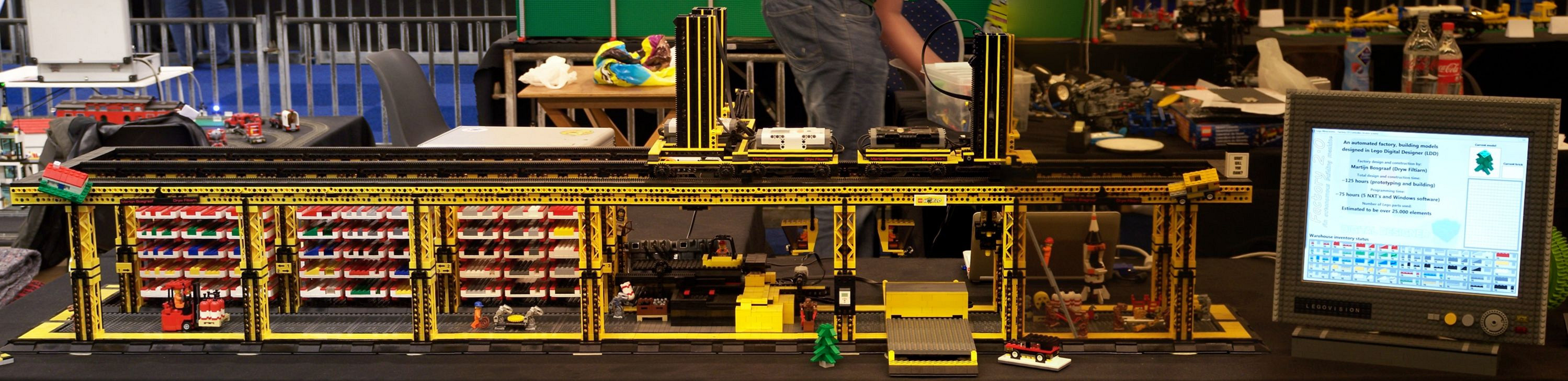
Details: It seems like just a few weeks ago that we were talking about an NXT robot that could print LDRAW designs. We've also seen an NXT-based warehouse for gathering parts, based on the LEGO company's own warehouse. Now, we see a bizarre combination of the two - a 5-NXT factory (staffed with minifigures to "drive" the various motorized parts) that gets parts out of a warehouse and then builds with them using designs generated from LEGO Digital Designer files. The choice of LDD instead of LDraw (like in the previous model-building 'bot) does limit things in a way, but any loss there is made up for by the ability to handle a large and easily changed set of parts. The warehouse contains 95 different types of bricks - over 1500 pieces total to build with. Most impressively, this entire thing was built and programmed in less than 5 months - it was only started in June of 2010. To see some work-in-progress and behind-the-scenes footage, look at the builder's other YouTube uploads.
Here's what the whole LEGOWORLD set-up of this factory looked like (click to "enbiggen"):
Details: The day has finally come. A LEGO robot is now capable of assembling a variety of LEGO models on its own, working off of LDRAW instructions generated in MLCAD. Would you like a robot like this? You can download instructions and programs for it in a number of formats, including MLCAD. That MLCAD file will be handy when a later version of this robot needs to know how to make other robots.
For now, though, this robot is limited to various 2xX sized bricks - 1x2, 2x2, 2x3, 2x4, and 2x8. This limits it to fairly simple models, but the concept has been proven. Actually, the concept, in a way, had already been proven by the robots that this LEGO 'bot was inspired by. MakerBot and RepRap can print any shape three-dimensional shape using extruded plastic. The plastic? It's frequently a type of ABS (acrylonitrile butadiene styrene) - the same sort of plastic used to make LEGO bricks (naturally, LEGO uses a variation on the ABS formula that is kept fairly secret). We already knew that the possibilities were endless, this was just the variation on this sort of robot that we all wanted to see.
...and speaking of which, if you want to see this in person (without building your own or a robot that can build one for you), you can see it at LEGO WORLD 2010 in Zwolle, The Netherlands, from October 22nd to October 26th, 2010.
Apologies for the late posts the past few days - I've been feeling very sick and having a hard time focusing. Things should be back to regular speed for the rest of the week, although I'm still pretty stuffy.
Details: Star Trek: Deep Space Nine was cancelled 11 years ago today. As with most of the Star Trek franchise, the show has maintained a lively following over the years that hasn't let go of the series. This is the main space station from the series, in microscale. Want to build your own? You're in luck! The builder has posted various in-progress photos on Brickshelf, and you can also download instructions in LDraw (MLCAD) and PDF format. Although most of the links above show computer renderings of this design (I'm pretty sure that the snazzy photo I've used for this post is actually just an exceptionally good digital render - but I didn't even notice at first glance!), a photo of one physically built with honest-to-goodness bricks can be found on Brickshelf.
Details: It's a little-known secret amongst bloggers who are LEGO fans that we always post our own stuff. It doesn't matter if we've featured 10 things more awesome recently - we're still going to blog everything that we build. I built this lamp quite some time ago, and only recently got around to writing about it. I thought it was about time since this will be on display in a very public way at this year's BrickFair, later this week.
Rather than go on about how clever I am for figuring out that you can build around a socket cord, I'm going to direct you to my personal projects blog at the link above if you want to see my comments about my model. I like to think I've provided enough information that you could go out and build your own lamp - and I've even included building instructions in LDRAW format for part of the model.
Apologies for how disheveled my personal blog looks (I spend more time on this one) - I'm just happy I finally got something written down about one of my own models.
Bram's Sphere Generator - tool that allows you to decide all the specifics of a sphere's dimension, and then creates a LDRAW file that shows how to build it with plates in a studs-not-on-top fashion.
Less immediately useful but a bit more convenient for those of us with no studs-not-on-top parts to spare is Timothy P. Smith's Lego Sphere Generator, which also generates output in LDRAW format. This is all studs-up, and the CAD file uses only 1x1 plates.
Another exciting option is LSculpt, which can create studs-out-in-all-directions plans for any shape at all.
There is one more option listed in that 1000steine post I linked to above, but I'd prefer not to recommend expensive software sold on a license basis (all of the options I've listed above are free). (yes, this is in place of a model today - just thought I'd change things up a little)
Details: I like to think that building a safe (or some other sort of security system) is a "classic project" for Mindstorms fans. I know it was one of the first things I tried building. Of course, it's a bit easy to just start taking the LEGO bits apart, so it's a project that usually gets abandoned before too much is done with it.
This builder, though, decided to order some special HiTechnic sensors and make the safe impossible to mess with. Sensitive to motion, it will trigger an alarm when tilted or pushed. The video above is essential viewing, and the website link includes an impressive amount of documentation, including code and LDRAW instructions.
Details: Although I have previously mentioned the Cave Racer craze, I somehow managed to not mention the Reasonably Clever Pigs on the Wing Contest where people were challenged to build cave racers piloted by animals. Be warned, not all contest entries are kid safe. Although there are many possibilities still not explored even after this contest (which ended yesterday), there are also a ton of very clever entries into this contest. My personal favorite is this one, where a counting sheep rides a cave racer that appears to have once been a bedroom set. Oh, and did I mention that two minifigs are still trying to sleep in that bed? They look pretty terrified, but at least they're LEGO® people, so it's not like their lamps aren't sturdily attached to their nightstands. I was actually surprised that this model still included all of the parts required to meet the contest's standards for cave racers, but they're actually all in there. This is also a computer-generated image (probably done in LDraw), but I do believe that this could actually be built too. Of course, the details here are as excellent as you'd expect for a model of the day - don't miss the goblet-and-rocket-booster lamps or the clever design of the sheep.
These models were both completed in 2004, but for some reason they only seem to be making the rounds recently. They are both phenomenal, though, and are well-worth the recent attention (and of course, they make for a fitting tribute to their inspirations' author). I'm thrilled with the information provided on these models - complete parts lists and LDraw-format CAD files. LDraw is a fantastic fan-created software program that allows for thorough documentation and instruction generation for LEGO® models (The official LEGO® CAD software, LEGO Digital Designer, does not include a life-like variety of parts, but does allow for special-ordering of parts and creations - personally, I recommend both software titles as well as MLCAD for LDraw.). Of course, the 3861 grey pieces used in the Discovery probably make this a bit difficult to try to make on your own, but you know, you could if you wanted to (of course, finding the parts could be a problem of it's own - and don't get me started on the differences between different shades of grey LEGO® pieces). The Leonov is a bit of a show-stealer, though, with motorized armature in it's middle. Oh, and apparently you can check out even more great "making of" action on these models in the first issue of BrickJournal.
These are Wednesday's and Thursday's models of the day.
Details: This is a LEGO sculpture of a Klein bottle made by the legendary knot theorist Andrew Lipson. OK, fine, he's actually legendary for his Escher-related LEGO models (Previously featured here). Complete LDRAW format building instructions are available for those of you who want to try this one at home. There are more pictures on this model's page as well. Take a close look at this one - I promise, it really is fascinating once you realize just what a Klein bottle is.

 We've touched on this design before, back when instructions were made available for it. Originally, it only existed in that digital form, but now one has been made of real bricks. A few minor modifications had been made (forcing a few parts into a dark green color, making some structural improvements), but otherwise the design is still the same. What makes it so special is that this model is being auctioned off on eBay as part of Creations for Charity, which is currently raising money for relief efforts in Japan.



 has maintained a lively following over the years that hasn't let go of the series. This is the main space station from the series, in microscale. Want to build your own? You're in luck! The builder has posted


 died this past Tuesday. Clarke is a widely-respected Sci-Fi author who is acknowledged as the first to propose the use of communication satellites in geosynchronous orbit. Clarke also wrote many famous Sci-Fi novels, including


