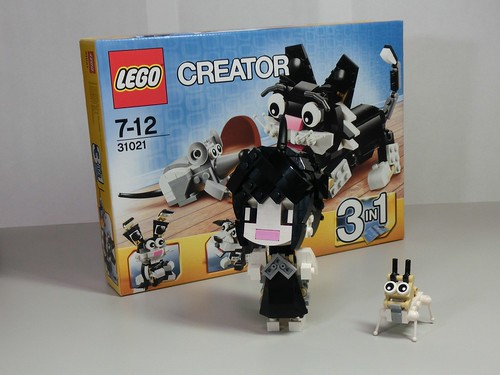
Details: Here's another clever alternate build, this one using set 31021: Furry Creatures. Normally, you'd expect such an alternate model to have more in common with the main model from the set - in particular, I think most of us would be tempted to use the large eyes (printed on 2x2 round tiles) as the eyes for the doll. This time, though, we see a few 1x1 plates for the eyes and the bright pink 2-wide cheese slope used for the mouth - a simpler but adorable solution for building a character's face. I'm also loving the uses of a wedge slope for her dress and the tail element for a bit of hair out of place.
Her pet is also a fun little build - a rare example of the bar-and-clip technique being used simply to reverse studs.
As an added bonus, the builder posted building instructions for the girl and her dog in this model's Flickr set.
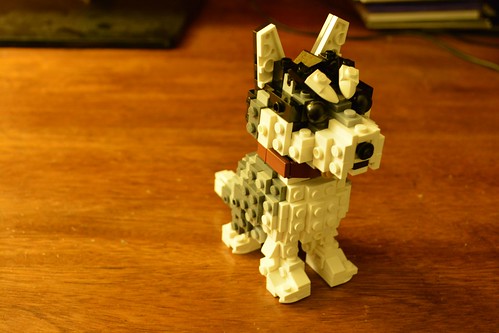
Details: This is one of those rare models that is technically interesting, aesthetically pleasing, and documented in freely available instructions. While the availability of specific small pieces and studs-not-on-top elements has meant that most people can't easily attempt this style of building, the reality is that it can be quite tricky to get the geometry to work out just right - it isn't easy even with all the right pieces handy. Having instructions (for something more complex than a Lowell sphere) is a great place to start, and should get more people trying this out (even if only to build other dog breeds).
There are some other nice details in the model as well. Note the use of 1x1 plates with teeth as claws and Bionicle ball joints as eyes. The "SNIR" (Studs-Not-In-a-Row) approach to the eyebrows is a clever way of filling in a gap that requires getting away from 90 degree angles, and a similar problem with the ears is solved by having them attached to Technic half-pins (which have a stud on one side and will allow anything attached to that stud to swing loosely). While a bit simpler, I'm a fan of the collar as well - it's a detail that makes the finished result more believable, and the studs-not-on-top geometry makes the cheese slopes look perfectly believable as a round surface.
Details: I always struggle to come up with good uses for the more specialized faceted wedge elements that LEGO has been making over the past 12 years or so (why, yes, I'm getting old, why do you ask?) - so it's a good thing people finding ways to make great spaceships with them facing in every direction are posting building instructions. Finally - awesome studs-not-on-top wedge-based designs for the rest of us. Now, if you don't remember the 90's and don't have any of that awesome windscreen element, don't worry - you can just change the design a little bit. The builder already has - don't miss the flickr set of variations on this design. There's a Power Miners version that is particularly great - the stickers from the kits give it a worn look. Some of the variations are actually based on Peter Morris' earlier design (Archangel) which you can also get instructions for.
Details:
Here's a new feature I'd like to get started on right away (mostly because I just found out about this great website): a spotlight on useful resources within the LEGO community. BRICKITGOOD is the work of Mr. Corey Sanders, a schoolteacher from Nevada who runs (and personally funds) an after-school LEGO program for elementary-school aged students. The site features a wide variety of models, with plenty of photos for each one. Most of the models also include instructions - some of which are in LEGO Digital Designer format so you can easily buy the parts needed to build them. An advantage (for teachers especially) of creating building instructions is that you can save designs while taking the models apart - which is particularly important when you need to make the parts available again for other students. In addition to creating instructions for his own designs, he has also created instructions for a number of popular models that haven't been available to the public (such as promotional items that were only given away as glued models). These models are a great starting place for your original creations - or you could try rebuilding some of the designs as shown. The events section covers student creations, regional events, and the 2004 Master Model Builder search (yes, when you build lifelike sculptures this well, LEGO takes notice).
The photos below show examples of the variety of material available on the BRICKITGOOD website, and each one is a link that takes you to the appropriate section of the site.
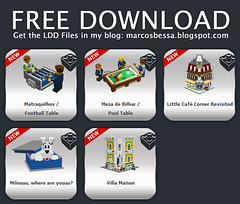
Details: Recently, LEGO set designer and frequentlyfeaturedbuilder Marcos Bessa has made available for free download the LEGO Digital Designer (LDD) files (useful as building instructions) for five of his models. Two of these models have previously been featured here as a model of the day, and all of them were built before he was brought into the LEGO company. Several of these models can be found in the portfolio used when he applied to join the company. Here are the links to the page for information for each model (each page includes information on the model, a link to photos on flickr, and a link to download the LDD file - along with a brief note regarding reuse of these designs):
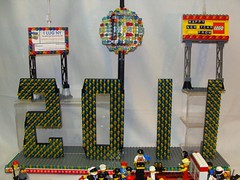
Details: It's hard to believe that 2010 is coming to an end. We've shared one model here for each of these past 365 days, and it looks like we're good to go for another year. I'm sure that most of my readers are familiar with the popular New Year's ritual of watching a large object dropped near a crowd in a large city - you may also be aware of the annual TV special that features the "ball" dropping in New York City's Times Square. Here we see the best part of that captured in LEGO form (sorry, Justin Bieber fans - most of us only tune in for the countdown). The "ball" here looks great, thanks to the mix of clear plates and translucent 1x1 round plates - apparently it's a variation on the design that Legohaulic provided instructions for. This model will be on display in the Rockefeller Center LEGO store for the month of January, 2011.
Details: We've found the perfect gift for the man who still thinks there isn't enough of Star Wars on their LEGO tree. Wait, what do you mean not everyone has a LEGO tree? Where do you put all the LEGO ornaments?
Anyway - this Death Star ornament design is all ready for you to give a try. Model instructions are available from the link above in both PDF and LDD formats. You can also download the parts list to try it with parts on hand, or if you're feeling adventurous, you can buy the parts through LEGO Digital Designer's Design By Me program.
Details: Plenty of exciting new items have shown up at LEGO Shop-at-Home recently. Among them are the new collectible minifigures. They're selling quickly (and with a limit of 5 per order), so if you want them you better hurry. If you're looking for an interesting way to display them, check out the links above - LEGO's "club" is offering complete instructions and parts lists to build a display podium (pictured here), a Ninja gate, a Skateboarder ramp, a saloon door for the Cowboy, and a stage for the Magician. Perfect vignettes for the minifigures!
Details: Here's a smaller project that's a little easier to try out - a miniature functional sundial. Full instructions for building this model and setting the sundial to work correctly in your area can be found at the website above. In addition to actually working as a sundial, this can be easily folded up and stored in a pocket - hence the "portable" bit. It's not terribly practical to use a sundial to tell time these days, but this project is easy enough and the documentation is thorough enough to warrant attention anyway.
Details: Star Trek: Deep Space Nine was cancelled 11 years ago today. As with most of the Star Trek franchise, the show has maintained a lively following over the years that hasn't let go of the series. This is the main space station from the series, in microscale. Want to build your own? You're in luck! The builder has posted various in-progress photos on Brickshelf, and you can also download instructions in LDraw (MLCAD) and PDF format. Although most of the links above show computer renderings of this design (I'm pretty sure that the snazzy photo I've used for this post is actually just an exceptionally good digital render - but I didn't even notice at first glance!), a photo of one physically built with honest-to-goodness bricks can be found on Brickshelf.
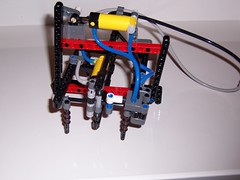
Details: I've previously blogged a fewinterestingwalkingmachines here, but the fact of the matter is that many of those models are a bit out of reach for most LEGO fans. The availability of various parts (specifically motors and pneumatic elements) leaves a bit to be desired. However, there's one current kit (the 8049 TECHNIC Log Loader) that is widely available and actually includes all the parts you need to try out simple pneumatic circuitry and walking machines. Naturally, I took this as a challenge - can a decent pneumatic walker be built out of only the parts in that one kit? You can see the results (and full building instructions!) at the links above. Spoiler alert: it can be done, but it took me a few tries to get it working smoothly.
Details: This isn't exactly a "model" for today, but it's an excellent resource that should help spur on some interesting ideas. Tora no Maki is a book in PDF format that is graciously offered as shareware - you can download it and evaluate it for free, but the author has asked that you pay $10 for it if you use it. Only the opening pages have text (in English and Japanese) - the rest is all full-color photos that clearly show off a variety of techniques. While it's intended to be an educational resource (and is certainly great for beginners - many of the techniques are straightforward and can be built with very few parts), it's still of use even for fairly advanced Technic builders.
This isn't a model per se, but Mariann Asanuma's new book is out. The book is called "Building Secrets from the Masters volume 2: Beyond the Ball" and it builds off of her previous book (I briefly discussed Mariann and her first book, "Building Secrets from the Masters volume 1: How to Build a Round Ball with Square Bricks!" last year). The book features ideas and building instructions for three models: an egg, a hot air balloon, and a watermelon. With her background as a former Master Model Builder for LEGOLAND, Mariann Asanuma naturally has created three models that would each be perfectly suitable as a model of the day.
Details: A while back, this builder built a beautiful fridge. Then, due to popular demand, a set of instructions were made. Now we are blogging them. Enjoy the minifig-scale goodness - it'll look great in nearly any minifig scale kitchen (and of course, those rare-ish curve elements used for the front are now available in enough colors for you to choose how to decorate your own fridge without having to resort to stickers as refrigerator magnets).
Peeron.com has updated their LEGO set instructions database to make all sets from 2006 available. The delay in making the instructions available has been a courtesy to the LEGO company - the guideline established over a decade ago is to not make instructions viewable online until 3 years after a set had been released.
Although Peeron is the most important online repository of LEGO set instructions, they're not the only website that offers this service. LEGO started offering instructions in PDF format on their customer service website some years back, including nearly the entire line from 2003 onwards. Searching these instructions has never been particularly easy, but one Adult Fan of LEGO (AFOL) decided to create a cross-reference a few years ago to make it easier. That resource was taken offline a few months ago due to the server load, but Brickset decided to take up the cause and has unveiled their new feature for it today. They've posted their details on their own New Years' post.
Speaking of which, our new year's post - a recap of new 2010 sets appearing at LEGO Shop at Home - will be up shortly.
Details: Color sorters aren't exactly new, but I think we all knew that the newer version of the NXT kit (the 2.0 kits include a color sensor) would lead to more designs, some of which would inevitably improve on what we've seen before. This one, with it's zany (but somehow perfect) angles and fast linkages, may be the fastest NXT-based color sorter possible. There are some clever mechanisms here for splitting the stationary set of balls into a stream of individual balls and for changing the ways that the balls fall. The video here is pretty exceptional at really capturing the details (I'm sure we've all had enough of Technic-related videos that don't show you enough to see all of what's going on). Building instructions and code (both NXC and NXT-G) are available from the link above.
Details: Modulex bricks are really little bricks LEGO manufactured for architects. They're now something of a rare collectors item - LEGO long ago outsourced their production, and has since given up on the Modulex brand entirely. They also come in strange colors that don't match normal LEGO colors. Another interesting feature is that they're reasonably scaled to be bricks that minifigures can build with. Oh, and did I mention that they make nice Christmas trees? The same builder has also built a larger tree and provided instructions on how to make this simple tree design.
Details: Here's another seasonal gift of building instructions - a gingerbread house (presented by BrickJournal magazine). Designed by former LEGOLAND Master Builder Mariann Asanuma, this is another masterpiece - and (assuming you can locate the parts in your own collection - a challenge, but in this case it is actually possible that a fairly small collection could contain all the right parts) you can even build your own! Alternatively, you could build your own similar house (a worthwhile challenge that has already been attempted by at least one builder).
Since I live in the US and we have insane consumer protection laws, I'm pretty sure I'm required by law to remind you not to eat any LEGO parts used for building gingerbread houses (please tell me you already knew not to eat plastic parts before the goofy law went into place to remind you about that...please!)
This is Friday's model of the day - and yes, we intend to catch up for Wednesday and Thursday yet...
Recently, the LEGO company posted instructions for a series of holiday models on their website. There's a good variety of models - life-size sculptures, minifig-scale characters, and even a few minifig-scale ideas. You can find those instructions (PDF format only, sorry) at http://shop.lego.com/HolidayShop/festivefun.aspx
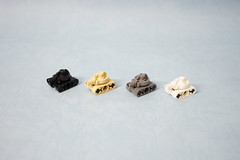
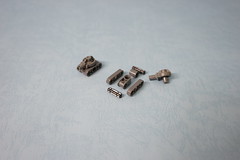 These fantastic microscale tanks are practically begging us to build some large battle scenes at a smaller scale. They make excellent use of the rotation joint element from the large Knight's Kingdom figures, which has always felt like a part waiting to be rediscovered. I figured someone would find a great way to use it as space-y greebling first, but it looks perfect as a tank turret here. The complete breakdown of how they were built should enable anyone to build these, with the possible exception of the center connecting the treads - the combination of Technic, Axle and Pin Connector Perpendicular and Technic, Pin Connector Round 1L can be replaced with Technic, Axle and Pin Connector Perpendicular 3L with Center Pin Hole (which is also available in more colors so far).



 fans - most of us only tune in for the countdown). The "ball" here looks great, thanks to the mix of clear plates and translucent 1x1 round plates - apparently it's a variation on the design that


 has maintained a lively following over the years that hasn't let go of the series. This is the main space station from the series, in microscale. Want to build your own? You're in luck! The builder has posted