Details: The latest addition to the exciting world of scaled-up LEGO elements made out of standard LEGO elements is this incredible rendition of the classic rubber band holder, a much-derided "useless part" that was seemingly inescapable in sets for about a decade. This particular build is about 8 times the regular size of the part, and makes great use of the 4x4 macaroni element to portray the Technic pin holes in the part. I'm also enjoying the use of curved-top arches and 1x3 curved slopes to capture the curvature at the edges of the part.
What elevated this part to a more beloved status was a joke by one LEGO fan about how "cool" LEGO pieces don't get named after builders who use them frequently anymore. Surely the LEGO fan community has been around too long and we'll never name a great piece after someone who used it well again. Nate "nnenn" Nielson figured that if a piece were named after him, it would be something like this rubber band holder (unfortunately, variations on this story have been told so many times in tribute to the man that it seems to no longer be possible to find his original quote in a quick search of the web). After Nnenn passed away, the decision to refer to this part as a "nnenn" was unanimous.
Details: These LEGO pieces are scaled up by a factor of three (3). The scaling isn't quite perfect (which isn't a slight against the builder - mathematically you just can't do this scale precisely enough on these elements without cutting LEGO pieces), but the parts still clearly look like their regular-sized counterparts. The use of curves near the top of the 1x3 slopes work surprisingly well. I don't believe these stack, but for obvious reasons that feature is difficult to work in when trying to build some of these elements at a larger scale.
Details: I like to focus on some pretty clever techniques here, but sometimes you can build a very detailed and pleasing little model without getting too fancy. This one still features some nice tricks ("headlight" bricks to use tiles as a realistic brick texture, pairs of round 1x1 plates stuck with string in the middle to make lights, rows of parts used to get architectural details, wheel well elements as window arches, etc.) but is largely built with standard bricks, standing up straight in a simple and elegant pattern. The scale is perfect, too - the house is the right dimensions to fit with "modular buildings" like Cafe Corner and Green Grocer, but the dark red section only goes up to a more classic town height of 7 bricks tall. The remaining three bricks' height before the roofline is done with various architectural details.
Details: To promote their song "8-bit trip", the Swedish band rymdreglage decided to put together a BrickFilm as the music video for the song. It wound up being a pretty spectacular BrickFilm, very craftsmenlike in it's use of bricks and plates to create something of high-resolution look. One moment we're seeing a large sculpture build itself, the next we're seeing flawless mosaics animate a scene (or render various classic video game characters). Technically proficient and animated in a more professional manner than most BrickFilms I've seen, this one's a winner just on the merits as a LEGO creation, before you factor in how well the video game references work.
The only thing to critique about this viral video's run around the Internet? The BrickFilm is so good that it seems to be distracting us from the song it's supposed to promote.
Today marks the 50th anniversary of the LEGO brick. LEGO has a press release about the history of the brick up in celebration. Google has a special logo it honor of it (screenshot). I haven't heard anything about them releasing any sort of anniversary bucket (Usually LEGO releases special anniversary buckets at unusually low prices to commemorate events), but there is an updated version of the 1958 Town Plan set (and the updated version does have special gold bricks). LegOficina dos Baixinhos pulled up the original Danish patent, where you can clearly see that the Godtfred Kirk Christiansen applies for a patent for LEGO bricks on January 28th, 1958.
Details: You may have seen some of these oversized bricks in some of the LEGO company's official displays and parks. They've also become fairly popular for amateur builders to attempt. At one point the LEGO company actually offered a generic scaled-up minifig for sale, but most of the builders who have tried similar things have gone with different scales for their scaled-up bricks and minifigs. This particular set is ten times regular size. The chef in particular features some great details and appears to be jointed! The use of slopes to help get some of the finer details might be a bit odd for a sculpture, but it works perfectly here.
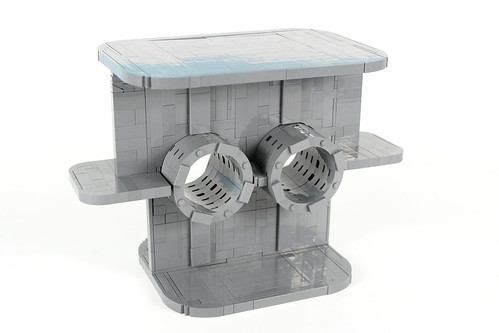 The latest addition to the exciting world of scaled-up LEGO elements made out of standard LEGO elements is this incredible rendition of the classic rubber band holder, a much-derided "useless part" that was seemingly inescapable in sets for about a decade. This particular build is about 8 times the regular size of the part, and makes great use of the 4x4 macaroni element to portray the Technic pin holes in the part. I'm also enjoying the use of curved-top arches and 1x3 curved slopes to capture the curvature at the edges of the part.


