Details: Here's another set of winners for our alternate models category - which recognizes great original creations based on parts from only one kit. In this case, there are actually 8 new models shown (all of which can be built with the 314 parts in set 8048 Buggy)- a motorbike, a plane, two trike designs, a helicopter, a wasp, a rabbit, and a dinosaur. As you would expect with alternate models from a Technic kit, some of these have working features - a knob in the back make the rabbit's arms move, for example, and the motorbike features working suspension and an engine with pistons that pump as you roll it along.
Details: You may have heard that it was Easter this past weekend. For the occasion, this builder created this spectacular sculpture of a baby chick with easter eggs. Although the building-in-all-directions technique is still fairly novel (and frequently done with the aid of a computer), this builder has started making it a main part of his style and incorporated elements that can't easily be specified in a computer-generated design. Note how the little wings are attached by a clip instead of being sculpted on. The use of round eyes and a nose pushed between studs perpendicular to it are also great touches (which also serve to emphasize that this design is more than just a computer-generated pattern).
Details: You may remember the first LEGO flexpicker robot built by today's builder a little over two years ago. While an excellent project, it wasn't the most realistic use of the technology - generally speaking, multiple delta robots are used together as part of an assembly line. Although that would be a mere quibble for most of us, it was reason enough for the builder to give it another go, applying various new techniques and algorithms to improve performance and reduce size compared to the original. A full description is at the site listed above.
Found at: ? (if you know of an official website or flyer for this event, please let us know)
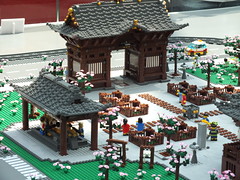
Details: Here we have one of the most difficult things to round up photos of - a large, apparently nameless (if it has a website or flyer, I haven't been able to find it) display built by many builders that will be on display for a fairly long period of time. You can visit this display from April 15th through May 2nd at Hong Kong's Cityplaza. We'll be trying to round up as much meaningful coverage of the event as possible.
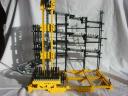
Details: You can use this ball clock to tell time. The third row tells the hours, the second row gives 5 minutes increments and the remainder is shown by the first row of balls. Mechanical logic keeps the balls flowing into the right places. In a technique I'm surprised I haven't seen in a Great Ball Contraption module yet, a ball lift is made out of chain with a few pieces of tread in the middle. Half-width beams are then able to attach to the treads. Building instructions for this model are also included in the Brickshelf gallery.
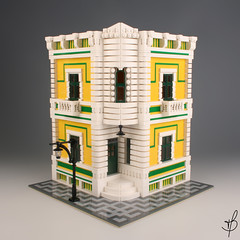
Details: We've touched on this design before, back when instructions were made available for it. Originally, it only existed in that digital form, but now one has been made of real bricks. A few minor modifications had been made (forcing a few parts into a dark green color, making some structural improvements), but otherwise the design is still the same. What makes it so special is that this model is being auctioned off on eBay as part of Creations for Charity, which is currently raising money for relief efforts in Japan.
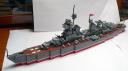
Details: I was having trouble determining the exact ship that the builder referenced in the title of this model, but this ship is based on a large soviet battlecruiser. The bold color scheme and microscale detailing help to make it stand out.
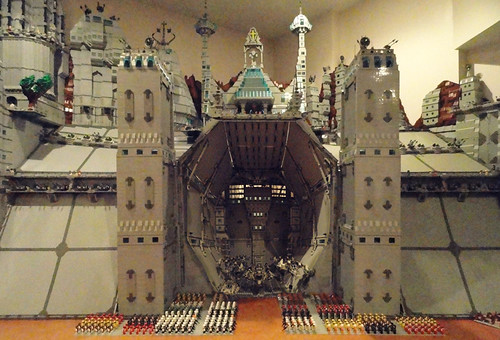
Details: We've seen other epic models before - but never anything quite this ambitious. This room-eating display was built in about 9 months by one person. In some of the photos, you can see a bit of a bridge and a couch. The LEGO bridge actually goes completely to the other end of the couch, where more is being added to this colossal model. One interesting technique used to quickly reach some of the heights seen here is using baseplates at various angles - in the image shown here, the large grey expanses are all 48x48 (15 inches square) baseplates. Don't miss the second centerpiece, which is a bit more Castle-y and features some great landscaping. The inside of the arena (behind the large statue) is surprisingly detailed considering how hard it must be to get in there and move the minifigs around.
I, for one, can't wait to see what's on the other side of that bridge.
Details: I've seen plenty of cakes over the years, but this one, erm, "takes the cake". The upside-down plates used in the middle make for a surprisingly believable cake-y texture. The frosting on the outside is similarly good use of texture - having studs face out in every direction captures the look better than tiles or the sides of bricks could. The 1x1 round plates (and the similar flowery element) make great sprinkles.
Details: People have been using analog film with LEGO pieces to make pinhole cameras for years, but this is the first one I've seen that is controlled by a microprocessor. The description offered falls just short of full instructions - the complete source code (which includes such features as a film winding angle calculator and shutter speed calculator) is available to view or download. Since it tracks how much film is left, you never have to worry about exposing the rest of the film before you want to.
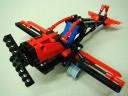 Here's another set of winners for our alternate models category - which recognizes great original creations based on parts from only one kit. In this case, there are actually 8 new models shown (all of which can be built with the 314 parts in set 8048 Buggy)- a motorbike, a plane, two trike designs, a helicopter, a wasp, a rabbit, and a dinosaur. As you would expect with alternate models from a Technic kit, some of these have working features - a knob in the back make the rabbit's arms move, for example, and the motorbike features working suspension and an engine with pistons that pump as you roll it along.