Posted by
Dan
at
4:53 PM
| Name of Model: Sign of the Times: Failure of the Fourth Estate |
| Created by: Mike Doyle |
| Found at: http://mikedoylesnap.blogspot.com/2014/10/sign-of-times-failure-of-fourth-estate.html |
Details: 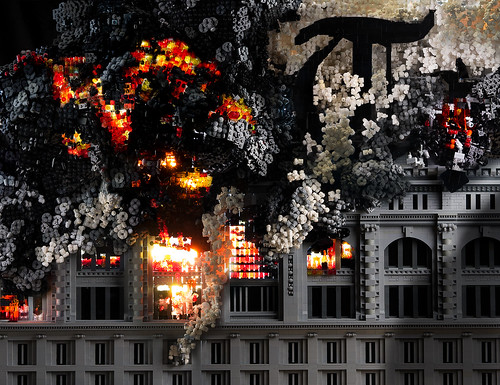 Mike Doyle has created another one of his signature artistic photos of an incredibly textured brick-built scene. This time, it's a poignant political statement about the state of mass media. Normally I'd be a bit hesitant to blog a political model here, but sadly, if you have even a passing knowledge of the LEGO world, you know that many media outlets find it extremely difficult to get even simple details right, like proper use of the name "LEGO" or terms like "LEGO bricks". It's a wonder that we trust the same outlets that very clearly can't cover simple matters fairly or accurately to give us the information we need about local, national, and world events.
That's before we get into the techniques used here - although Mike Doyle's models are only designed to be viewed from one angle, the craftsmanship involved is always top-notch. The backlit fire and smoke features some fascinating angles, most of which seem to be supported with plates with clip lights - which is not the sturdiest connection, so presumably something clever is used in the background to keep the smoke from falling over. Round plates (both 1x1 and 2x2) seem to handle most of the billowing smoke. The included part of the Times logo is a spot-on mix of various slope elements that works without any of the standard mosaic techniques. A visible piece of netting and some bar-and-clip elements hints at additional support for the smoke. The building itself looks a bit simple, but is very effective, making use of the undersides of plates, repetitive parts, and the 2:5 ratio (2 studs wide is the same distance as 5 plates tall - seen here in the window frames) to capture architectural details.
The use of color for the fire and windows may actually be the most noteworthy feature here - Mike Doyle has cultivated a very unique aesthetic based on heavy use of black and white, which makes the color here pop more than it usually would - and makes it all the more impressive that he already seems to have mastered mixing different translucent colors to get the fiery effect seen here.
In addition to reading about this model here and on Mike Doyle's blog, you can also see it on MOCpages and Flickr.
LMOTD previously covered Mike Doyle's Three Story Victorian with Tree, blog (update) and Two Story with Basement. We seem to have skipped his two books and other MOCs.
|
|
Posted by
Dan
at
4:00 AM
| Name of Model: Mona Lisa, redux |
| Created by: Eric Harshbarger |
| Found at: http://www.ericharshbarger.org/lego/mona_lisa_2.html |
Details:  I've previously blogged a mosaic by Eric Harshbarger depicting the Mona Lisa. This particular one focuses on the face (this simplifying the image a little bit) but also brings out more detail by using a wider color palette (10 colors instead of the classic 6) and the more high-resolution studs-up technique. LEGO mosaics can be built studs-out (with the LEGO logo on the top of the parts facing you when you view the image) or studs-up (with bricks and plates stacked on top of each other so you see the side of the parts when you view the image), and the two approaches result in very different images. The studs-out approach allows you to treat LEGO parts as if they were square, making a 1x1 brick pretty similar to a pixel on your computer screen. The studs-up approach forces the builder (or computer program, more often than not) to account for the 5:6 ratio in LEGO brick width to brick height, or a 5:2 ratio in plate width to plate height. A studs-up mosaic using plates can get a resolution 2.5 times better in one direction than a studs-out mosaic can - but in the other direction, you're still limited to the width of 1 LEGO stud as the smallest measurement you can show. The end result is that this is almost as close as you can get to photo-realism in LEGO bricks (you could still get slightly more precise by combining this technique with studs-not-on-top techniques to change the direction of the plates, and thus change which direction has higher resolution - but that will drive all but the most seasoned LEGO professionals insane). |
|
Posted by
Dan
at
4:00 AM
| Name of Model: MC Daly Building |
| Created by: Bisonfuehrer |
| Found at: http://www.flickr.com/photos/bisonfuehrer/4401683924/ |
Details:
 Another micropolis masterpiece. While using translucent parts isn't exactly a new technique, it's used to great effect here. The trans-black color works really well with the black plates. If you study this design closely, you'll see that there are a few places that don't line up quite the way you'd expect. Those details are achieved by using the flat side of log bricks - since those are a little narrower than normal bricks at the ends, they can be used to add a bit more texture. |
|
Posted by
Dan
at
4:00 AM
| Name of Model: LIU - Napu Art Museum |
| Created by: Emperor Ludgonious |
| Found at: http://www.mocpages.com/moc.php/186983 |
Details:
 There are quite a few interesting challenges one can take when constructing a large building out of LEGO parts. You could try making it in Space with unusual size, with certain types of artwork or architectural details...the possibilities are endless. In this case, we have a large, well-designed art museum in Space. Naturally, there are plenty of interior photos showing the various pieces of "artwork" that have been carefully constructed with little LEGO pieces. You can guess from the photos how to assemble the various works, but most of them aren't terribly sturdy - they're just laid into place to get the right image to appear. There are some other interesting techniques to pick up here as well - get a look at the front railings, the picture lights, the sideways floors (in most of the photos you can see smooth floors that are actually the sides of bricks) with benches built into them, and the zany sculptures. |
|
Posted by
Lego Model of the Day
at
4:00 AM
| Name of Model: Mondrian Tribute | | Created by: Moose Greebles | | Found at: http://www.flickr.com/photos/moose_greebles/sets/72157618325959859/ | Details:
 Although it may seem obvious to some to combine LEGO bricks with boxy geometric art, I've never seen such a clever tribute to Piet Mondrian as this one. Extra points are won for the cubic shape of the sculpture, the spectacular use of plates (parts 1/3 the height of standard LEGO bricks) to make thin black lines, and the demonstration of some exact square shapes in brick form (sure, it's not hard to do the math, but it's surprising how rarely we see a perfect 6x5 square in a LEGO model). Some studs-not-on-top detailing helps to make the 5 shown sides (the bottom is solid black) of this cube look even better - note the inlay on the top, complete with a handle to open up the box. I also love that the LEGO parts actually end up looking less like a grid than the original paintings do - a testament to both artists' skills. |
|
Posted by
Dan
at
8:55 PM
| Name of Model: Swedish church unveils Lego Jesus statue for Easter | | Created by members of the Oensta Gryta Church in Vaesteras, Sweden. Photo and summary provided by AFP. | | Found at: http://www.google.com/hostednews/afp/article/ALeqM5jfvsy2G44S1zgbkMgubhgKUEEPuQ | Details:
Although the vast majority of LEGO creations I've seen touch on religion do so in a disparaging or satirical way, a bona-fide piece of Christian art has, erm, "arisen" this Easter Sunday. I'm hoping more photos surface soon, but a quick search for information on the church behind this didn't turn up anything interesting (if you're in the area and can report back on whether people are allowed to view this piece in person, please do). Some short blurbs related to this (no serious articles about it have arisen yet) mentioned that this approximately 6-foot tall sculpture was based on an earlier marble sculpture - which was also the rationale for white being the primary color here (other colors were used internally for structural support).
|
As a newswire service AFP does not obtain release from the subjects, individuals, groups or entities contained in its photographs, graphics or quoted in its text. Further, no clearance is obtained from the owners of any trademarks or copyrighted material where the marks and material are included in AFP photos or content. LMOTD has extended them the same level of courtesy and will change the featured photo and linked article in this post when made aware of similar resources from a more reasonable outlet.
|
|
|
|


